Reading Resource: Bunsuke

日本語の練習 第135週

Japanese Practice Week 135

2022年06月26日「日」第135週 

日本語のイベント/EVENT IN JAPANESE

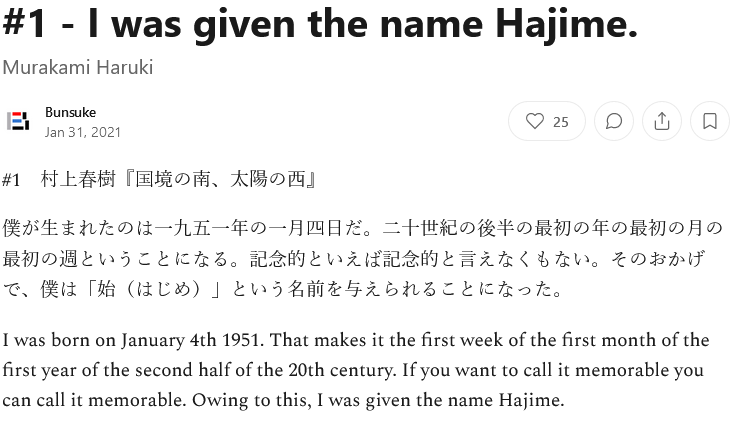
キングダムハーツのプロジェクトを書くとき、Substackというブログサイトを作くりました。そのとき、色々なブログを見つけました。今日はBunsukeの事を話したいです。Bunsukeさんは文学で日本語の語彙と文法を教えています。このブログは日本語を使いますけど、英語に翻訳します。しかも、語彙と文法はひらがなも英語も使います。読書力を上達させたいなら、これはおすすめです。

N3 文法

[ために2]

because of, as a result of

Not only is this grammar used to state a reason someone does something, it can also express a cause.

N +のために
V[Plain-form] + ために
いーAdj + ために
なーAdj + ために

Ex: 彼女は小学一年生のために、漢字をあまり読めない。

(She can’t read that many kanji because she is a 1st grader.)

Ex: 僕はテレビをあまり見ないため、人気番組の事を知らない。

(Because I don’t watch much tv, I don’t know what is popular.)

Ex: 今日はとても暑いため、出かけたくない。

(Since it is very hot today, I don’t want to leave the house.)

Ex: 彼は真面目なため、あまり冗談は言わない方がいい。

(Because he’s a serious guy, I wouldn’t joke around with him.)

[たらいい・といい]

it would be nice if, should, I hope

This grammar has various usages. You can use it to suggest that something should be done.

V[Past-tense] + たらいい
V[Plain-form] + といい

Ex: クッキーを焦がさないために、タイマーをセットしたらいいですよ。

(You should set a timer, so that the cookies don’t burn.)

You can use the following to express regret or regret of a past action.

  • けど・が
  • よかった

You can add のに convey a deeper sense of regret as well. If you want to be more formal が or のだが would be better.

Ex: 合格しなかった。もっと勉強したらよかったのに

(I didn’t pass. If only I had studied more.)


N3 動詞/N3 VERBS

収穫する
しゅうかくする
harvest; crop, fruits (of one’s labors); gain; result; returns
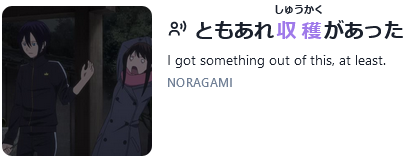
収 = income, obtain, reap, pay, supply, store
穫 = harvest, reap

With this verb you are reaping the benefits of what you sewed into. Like Yato here.
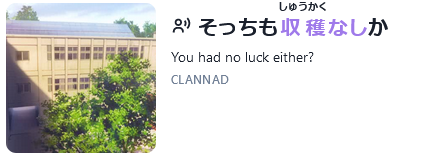
Interesting thing about this word is that you can add なし to it to mean that you can’t benefit from something. Trying to look for something but can’t find it? 収穫なし. Worked really hard on something and it didn’t result in a good outcome? 収穫なし.


対話/DIALOGUE

Taking a trip to Texas… yay~
暑い (-_-;)

[Let’s go to Texas]
A: Yo, Mitsuki. Are you ready for the trip?
B:I am, but I’m not really looking forward to this flight.
A:Well, why? Do you want to go to Texas?
B:I want to, but traveling to a place like that in the summer…
A:Oh, I see. It’s so hot, isn’t it?
B:Right. But I want to see my sister, so it can’t be helped.
A: Yeah I get you. Why did she move to such a place?
B:Well. She wanted to move to Texas for ages.
A:Then, how about we go to a lot of cooler places when we get there. How about we go to the beach?
B:Sounds fun. Oh, shoot.
A: What’s wrong?
B: I forgot to get a new swimsuit.
A: What? Do you plan on shopping for one now?
B: Nah. Sounds like a pain, so I’m going to go buy one when I get to Texas.
A:Okay, let’s go to the airport.
B:Yeah. Let’s go!

[テキサスに行こうぜ]
A:よ、ミツキ。旅行の準備をしたか。
B:準備はいいけど、このフライトをあまり楽しみにしてないんだ。
A:え、どうして?テキサスに行きたいの。
B:行きたいけれど、夏にこんな場所に旅行するなんて。。。
A:あ、そうなんだ。めちゃ暑いよね。
B:でしょう。でも、姉ちゃんに会いたいから、しょうがないね。
A:だよね。なぜそんなところに引っ越したのか?
B:さー。ずっと前にテキサスに引っ越したいんだ。
A:じゃあ、着いたら、涼しいところにたくさん行くよ。海に行かない?
B:面白そう。あっ。
A:どうした。
B:新しい水着を忘れちゃった。
A:え?買いに行くつもり。
B:ううん。めんどくさいから、テキサスに着いたら、買いに行く。
A:よし、空港に行こうぜ。
B:うん。出発!


タイトルを見る/WHAT’S IN A TITLE
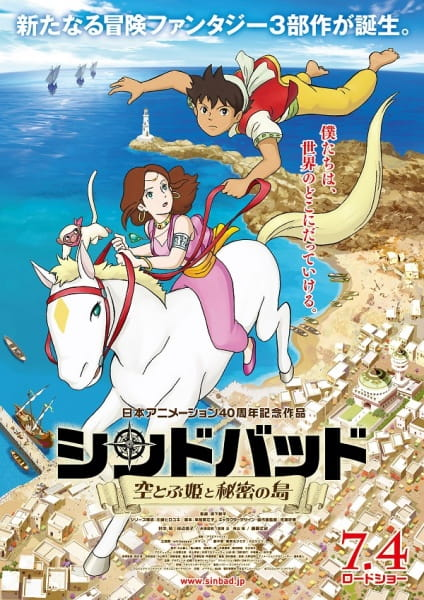
シンドバッド
空とぶ姫と秘密の島

シンドバッド

This is a name of the boy in the poster: Sinbad. Not the comedian, the pirate.

空(そら)

Not “that” Sora. But if you look at his eyes, they are as blue as the sky. Which this word means.

とぶ姫(ひめ)と

I found this a bit weird but since there is so many kanji, I guess they didn’t want use kanji for とぶ. This is the verb 飛ぶ(とぶ)and it means to fly. When a verb is placed beside a noun in this way, it is usually giving a description to that noun. Someone or something is flying in the sky.

So who or what is flying? 姫, that’s who. But what is that?

姫 means princess. As you can see from the poster a princess is flying in the sky… on a horse. Strange.

This brings us to the と particle. From the looks of the overall sentence, it is safe to say that this is “and”. Think of it like it’s a Harry Potter Book. Harry Potter and the… 

I think I’ll cut out the word sky from the final translation and just put the word flying instead.

We have “Sinbad: The Flying Princess and the ”

秘密(ひみつ)の

The first and second  kanji have the same meaning: secret. Together it can mean secret or mystery. Secret sounds too straightforward, so I think I’ll go with a synonym. I think I’ll go with “mystic”.

島(しま)

Speaking of Sora a little earlier, he lived on a 島. 島 means “island”. Paired together with 秘密の and my translation of 秘密、 you get “mystic island”.

With a little sprucing up, we get:

Sinbad
The Flying Princess and the Mystic Island

Close to the official translation. The title comes from a movie about a young boy named Sinbad. This is the first film in the series. Above the title is a description. This movie seems to be the 40th anniversary for animation in Japan. Can’t really recommend this anime. It’s not that good, but if you want a simple fairy tale like story and want to work on your Japanese listening skills, it could be a good film for you. I watched it on Amazon Video but you can probably find it in other places.

Here’s a trailer:


救世の大冒険/KYUUSEI’S ADVENTURE

第9

少しだけ観光したいから、マダツボミの塔に行った。真ん中にピーラーがある。なぜ揺れるのか?あ、上に熱いポケモン勝負があるんだ。危険だろ?あ、そうなんだ。この塔は柔構造という建物だから。地震に負けない建物、大丈夫。トップに上るため、坊主たちを倒した。目の前には最後の坊主がいるらしい。坊主・ボスみたいだ。チームが疲れそうだったから、ポケモンセンターに行くと思う。

周りを歩きながら、新しいルートを見つけた。行きたかったが、男が俺を止めた。なんというか「ジムリーダーを倒す」と言ってた。それで、マダツボミシティのジムリーダーを倒すまで32番道路に行けない。サイアク。

塔の頂上に帰ってきた。あのピーラーを通り過ぎようとした矢先に、ドカンと音がした。どうしてあの奴がここにいるのか?!いちゃった。「弱いとか強いとか」のくだらない話をし続ける。落ち着いたほうがいいだろ、あの奴。穴抜けのㇶもをみつけた。お、そうか。これであの奴が出かけた。ともかく、坊主・ボスは厄介なホーホーがいた。あのホーホーはハナビに困ったが、ハナビは勝った。よっしゃ!ついに、炎のタイプ技を覚えた。

勝負のあとで、フラッシュというひでんわざをもらった。これであの真っ暗空洞を使うのか?まず、このシティのジムバッジをゲットする。次は、ここに来るぞ。

9

Visited a place called Sprout Tower. There’s a pillar in the middle. Why is it shaking? Oh it’s because of Pokemon battles. Isn’t that dangerous? Ah, I see. This tower is a jukozo kind of building. It can even handle earthquakes, so I guess it’s fine. Fought a bunch of monks to get to the top of the tower. Looks like there is another guy up ahead.  Must be the boss. My Pokemon are getting tired so I think I’ll heal them up.

While I was walking around I found a new route to catch Pokemon but this guy stopped. He was talking about beating the gym leader in the city. So I can’t go to Route 32 until I beat the gym leader? That sucks.

Made my way back up to the tower. Right when I was about to walk past the pillar, there was a loud noise.  What the heck is Keiji doing here? And he’s gone. He’s still going on about what is weak and strong. Dude needs to chill. Found an escape rope. Oh so that’s what he used to leave. The boss had a Hoothoot. It gave Hanabi a bit of trouble but she finally learned a fire type move. 

After the match, he gave me an HM called Flash. Oh, so I can use this on that dark cave. But I need to get the badge in this city. Guess we’ll head there next.

In conclusion, I hope that this series is helpful with your journey to learning Japanese and/or taking an interest in the country’s culture. Until then… また来週!

Summer 2022 Goals

I think I’ll take it a bit easier on myself this summer. There are so many things I want to get done, so I’ll do my best.

Japanese

Read a book every month

Starting in July I’d like to start reading one book a month. I have some books in mind but I also want to give myself a challenge. I don’t plan on reading web novels. I don’t think I’ll be able to finish that in a month. I want to know what happens next in the ones I was reading so I’ll read those at my pace.

Beat Kingdom Hearts in Japanese

I finally got my copy of Kingdom Hearts 1.5 + 2.5 Remix a couple of weeks ago. I’ve been playing it on my old account so I don’t get trophies on my new one. But as soon as tomorrow gets here. I’m definitely playing it.

And considering I basically made my own game script for the game I should be fine. Just wish I knew game scripts were a thing when I was doing that project (-_-;).

Finish Reading Kanji de Manga: Yojijukugo

四字熟語 are 4-compound kanji words. I like word play and would like to know more of these. Maybe I’ll make a sentence for each one and put it on the blog.

On another note I don’t think I’ll read an article a day this time. Sometimes I forget and end up having to read 2 or 3 articles at once. I still read them from time to time since they are helpful. Speaking of articles I think I’ll start translating one article a month for now.

Programming

Complete Unreal Engine 5 Course on Game Dev

Gamedev.tv has a some great courses and I bought some of them on Humble Bundle. We are finally getting into next gen gaming with Unreal Engine 5, so it is best to jump on this course as soon as possible.

But first, I want to get my bearings with C++. Then I’ll take the Unreal Engine 5 course.

Complete JavaScript on Free Code Camp

I completed the Web Design course on freeCodeCamp.org but they have plenty more courses I can take. So I’ll be taking on JavaScript next.

I’ll also be tackling Python on there, but it doesn’t look like it will be like the Web Design and JS courses. Just want to go at my own pace with Python. They also have one on machine learning, but I’ll see if I can get the others done before going into that.

Finish Python Crash Course Book

I know a bit of Python thanks to this book. However, I’m a little rusty so I’ll be starting from scratch. I already got PyCharm set up and ready to go. Wonder if I can make some games on this too. We’ll see but first I have to finish this book.

Shogi

Solve 5-move Tsume Puzzles

I don’t have anything extravagant for shogi this time. There’s about 63 puzzles that I can solve in my Tsume Shogi Book. I think that is enough to get me through the summer.

SPRING 2022: プログレスリポート

I used to put these with the weekly blog. I think it will be better off as a separate thing from now on.

Before I start my Summer goals I’d like to go over what I accomplished this Spring.

SHOGI 将棋

Thanks to 3月のライオン, I became interested in playing Shogi. I started doing tsume puzzles back in 2017 with a paper mat and a wooden pieces that I got from Yellow Mountain Imports on Amazon.

I picked it up every now and then while playing against a computer. But I decided to get better at the game and made some goals.

Finish Tsume Puzzle Book up to 3-moves.

Started with a somewhat simple yet challenging goal: Tsume Puzzles. There are probably many tsume shogi puzzle books out there, but I used this one:

The 1-step puzzles were relatively easy. At first it was hard to get through the 3-step puzzles but, I noticed my pace got faster mid-way through.

Finish Reading Shogi for Beginners

Bought this a couple of years ago when I was lucky to buy it new at a cheaper price. I don’t have a clue why it costs $57 right now (高すぎ). It was $15 + shipping to get it off of Amazon back then. Had some gift card money so I only paid about $7 (ラッキー★).

Nonetheless, the book maybe old, but it was worth the buy. After two years, I finally put it to good use. It has all you need to get started: Rules, Strategies, Tsume Puzzles, and more. Was not expecting to do 7-step shogi puzzles in this book, though. They were hard but I got through them.

This book helped with my endgame goal for Shogi and that was…

Beat Lv. 5 in Kanazawa Shogi Level 300

“But Isiah, why don’t you play against an actual person”. I hear you loud and clear. However, I’m more of a solo player. Plus, going up against someone on 81 dojo was quite intimidating before getting a better grasp of this game.

So that’s when Kanazawa Shogi came in handy. Bought this back in 2017 with that Tsume Shogi Book. Decided to beat it two times on each level before getting to my goal: Level 5.

PROGRAMMING プログラミング

Finish Web Development Courses on Zenva

Bought these courses on Humble Bundle. Might as well get into them now. They were pretty short but they had some use. Especially how to comment faster on html.

Just highlight the text and push “ctrl + /”. Came in handy for my other goal.

Finish 2D Game Course on GameDev.TV

Another course I bought on Humble Bundle. I’ve been wanting to make games and use my Japanese a little bit in them. I’ve done it with a couple of the games I made in this course.

Also made a space invader kind of game. Here’s a demo that you can play.

https://sharemygame.com/@haixis/lasers-demo

Finish Responsive Web Design Course on freeCodeCamp.org

I did this along with the GameDev Course. Took about a month but I wish I would’ve started sooner. Kind of procrastinated and didn’t start doing this until late May.

I’m a bit confused on why it doesn’t have my final touch ups when I go to projects though. Luckily, I was able to get it to show up on my CodePen.

It was a useful course. I even got a badge on LinkedIn because of this course.

JAPANESE 日本語

Finish Reading Learn to Read in Japanese

After doing poorly on the reading section on the JLPT N3 practice test, I decided to work on my reading… by learning how to read more kanji.

It was a long book but very worth the time. It has romaji and literal translations on the ride side of the Japanese text, so it’s good for picking up grammar as well.

This huge book came in handy. It went over 608 kanji. This book has helped me to read faster and recognize more kanji than before I started reading it. I even got a physical copy of the second volume for my birthday.

And it is bigger than the first one: 600 kanji. So with these two books, I could possibly take on the N2 next year.

Clear Tokyo School Life

Wanted to play a game in Japanese and this was the perfect one at the time.

Planned on finishing just one route. Ended up finishing the whole game (笑). You can put Japanese on the main screen to help practice your skills. You can change it to English though. There’s a sub window, too. You can change the text to English, Japanese, romaji, or hiragana.

There were 3 routes you could choose from depending on your choices. Technically there are 4 but… will get into that later. I’ll talk briefly about each route from the best to the worst in my opinion.

Aoi Route

This is the best route. She may be small but man she can kick ass. Aoi is the designated mother of the house. On top of that, she knows karate. During her route, you go on a school trip to Osaka and message her grandpa who is a former yakuza. Out of all the girls you get to hang out with Aoi the most during her route. I also enjoyed learning more about her and her ties to the yakuza.

Sakura Route

Sakura’s route is good and I did enjoy going to Akihabara. She may seem a bit close minded but she is die-hard otaku. So what’s the problem? I wish that I could get more time with her during her route. In her route the school trip is in Kyoto. Would have loved to hear talk more about the history and culture behind the shrines and castles. Due to some circumstances, that doesn’t happen much. Heck and the ending threw me for a loop… in a good way.

Karen Route

Karen may have less going on in the drama department but I didn’t like Karen that much compare to the other girls. You don’t get to hang out with her in Okinawa so that already blows. Due to her job as an idol, I guess it couldn’t be helped. Plus, I don’t like tsundere characters and her obsession with cute and the mayo… oh God the mayo. Nonetheless, I do like that she finally chose what she wanted to do at the end of her route instead of just sticking to one image.

No Maidens Route

Lastly, what I like to call the “No Maidens Route”. I had to start the game and hit the skip scene button to get to this one. This game depends on your answers to the girls. If you give them an answer they don’t really care for their affection points won’t go up.

Read 2 Web Novels

I only read the first chapter, but they were relatively long (especially the ones on Kakuyomu)

【朗報】俺の許嫁になった地味子、家では可愛いしかない。1章

Reading the manga but it comes out monthly so I started reading the web novel. With just the first chapter, I’m already quite ahead of the manga. Kinda wonder if this is how manga readers feel when they already know what will happen and are looking forward to what scenes are going to be animated.

継母の連れ子が元カノだった

Reading another series by the writer called I’ll Solve Your Mystery. It is getting an anime this summer, so I might read more as it is airing.

Read 4 Manga Volumes

1。名探偵コナン3巻

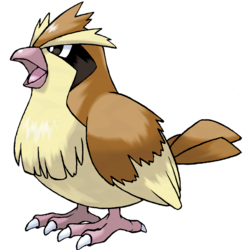
Great manga as usual. The Detective Boys and the shoes show up in this volume. I plan on reading more and commenting on every chapter on MAL.

2。愚かな天使は悪魔と踊る1巻

This manga took me for a loop right from the start.

The first chapter was long but it didn’t feel like it.
It went from comedy -> fateful encounter -> shonen battle -> S&M.

Here’s a bit of info from one of my posts.

The story starts off about a devil coming to the human world. For the sake of his world being in peril by the angels and loss of morale in his comrades, he is ordered to find someone with a lot of charisma. Luckily as soon as he enters high school, he finds that charismatic person. Unfortunately… turns out she is is mortal (immortal?) enemy, an angel.

While I was reading the first chapter, I was wondering why people were comparing it to one of my favorite manga, Kaguya-sama, but after finishing the first volume I can kinda see why.

Considering how good the premise and art is, I’m sure it will get picked up for translation soon. Heck it might even get an anime adaptation one day. In the meantime, I think I’ll keep reading it on BOOK★WALKER.

3+4。ココを異世界とする!

This manga was okay. A happy-go-lucky girl making a club focusing on Isekai. She ends dragging a few other students in as they all try to come to terms with their own struggles. The manga sort of ends on a dull note though. They were on the brink of being disbanded because they didn’t that many members but if you take a look at the first chapter, it seems they are going to be okay. I still wanted to know how they won over the class rep though.

I do like the Persona 5 like text every now and then.

Finish Digimon on Animelon

🎶ゴキゲンな躇になって きらめく風に乗って 今すぐ キミに会いに行こう🎶

Feels great to go back to one of my first anime. Digimon Adventure 01 still holds up to this day. I wish that Animelon had Adventure 02 though T_T.

Read an Article/day

I missed a couple of days but I just read two the next day.

Since it was Father’s Day yesterday, I thought it’d be nice to read this as the last article.

It was a survey of best dads in anime. They show a top 20 (don’t know why Gendo Ikari is there) but I’m surprised that Minato is so high on the top 10. Glad to see Kogoro and Yusaku on the list though.

A Little About the U.S.-Japan Bridging Foundation

日本語の練習 第134週

Japanese Practice Week 134

2022年06月19日「日」第134週 

Hello everyone! Found a good YouTube Channel if you are interested in getting thoughts about working in Japan or working closely with Japanese companies.

日本語のイベント/EVENT IN JAPANESE

最近、日本語系の仕事を考えています。翻訳者になりたいと思ったので、Zoomでセミナーに参加しました。

色々な意味で、役に立ちまして、勉強になりました。日本に働きたいとか日本語系の仕事を探したいなら、このユーチューブ・チャネルをご覧ください。

https://www.youtube.com/channel/UCJ-SMuu3Gn9go92GRwbx6aQ


N3 文法

[たびに]

each time, every time, whenever

V[Dict Form] + たび(に)
N + のたび(に)

This grammar is used to express every time you do a certain thing, something occurs. In regards to nouns it can be thought of “for each/at every [noun], there is”.

Ex:あの曲を聞くたびに、ピアノのアレンジを習いたくなります。

(Every time I hear that song, I want to learn how to play it on the piano.)

Ex:問題のたびに、回答があるでしょう。

(For every problem, there’s a solution, right?)

[ために]

by means of, due to

V[Dict Form] + ため(に)
N + のため(に)

Can be used to state a purpose of an action.

Ex:日本で働くために、プログラミングと日本語を勉強しました。

(I studied programming and Japanese in order to work in Japan.)

Ex:夢のために一所懸命に頑張る人はかっこいいと思う。

(I think that people who work their hardest for their dream are cool.)


N3 動詞/N3 VERBS

集中する
しゅうちゅうする
concentration (on a task), focusing one’s attention

集= gather, meet, congregate, swarm, flock
中= in, inside, middle, mean, center

So what I can gather from these kanji is that something is being collected at one point. Imagine gathering a bunch of items and putting them in a chest that is in the center of a room. The goal is to fill the chest. So you are focusing your attention in order to get the task done. You are concentrating. Just like the orchestra band in Sound! Euphonium are concentrating on practice so they can win their competitions.

This verb also has another meaning of concentrated volume of something. Like heavy traffic or a lot of people in a place (think that’s called population density) .


対話/DIALOGUE

It’s almost summer… so why not go somewhere, right?

[夏休み、デイズニーランド行こうぜ]

A:夏休みそろそろだね。予定あるの?

B:別に。多分ゲームしたり、本を読んだり、映画を見に行く予定だ。

A:普通でしょう。

B:しょうがないでしょう。子供だし。

A:まあそうですけど、旅行したい。

B:どこに?

A:さ、ディズニーランドかも。

B:あ、いいと思う。両親たちに聞いてみる。

A:無理だって。料金が高すぎない。

B:いいから、いいから。そういえば、記事によると、子供の料金が半額。

A:えー、それなら、チャンスが高そうね。聞いてみようか。けど。。。

B:けど?

A:夏休みの宿題を終わらせよ。

B:げ、なぜそっち。

A:いいから、いいから。一緒なら、大丈夫だって。ディズニーランドに行きたいの?

B:行きたい。一緒に頑張るぞ!え、えー

AとB:お!

[Let’s go to Disneyland for Summer Vacation]

A: It’s almost time for summer vacation. Do you have any plans?

B: Nothing. I’m probably going to play games, read books, and go to the movies.

A: That’s a bit boring.

B: What can we do about it? We’re kids.

A:Well, yeah, but I want to go somewhere fun.

B:Like where?

A:Maybe Disneyland.

B:Oh, that sounds good. I’ll ask my parents.

A:They said that I can’t. It’s too expensive.

B:It’ll be fine. Speaking of Disneyland, I read an article. It said children get in at half price.

A:Well, I guess our chances are good. I’ll ask them. But…

B:But what?

A: We have to finish our summer homework.

B: Ugh, why?

A: Oh, come on. It’ll be fine if we do it together. You want to go to Disneyland, right?

B: I do. Alright let’s do it! Let’s…

A and B: Go!


タイトルを見る/WHAT’S IN A TITLE

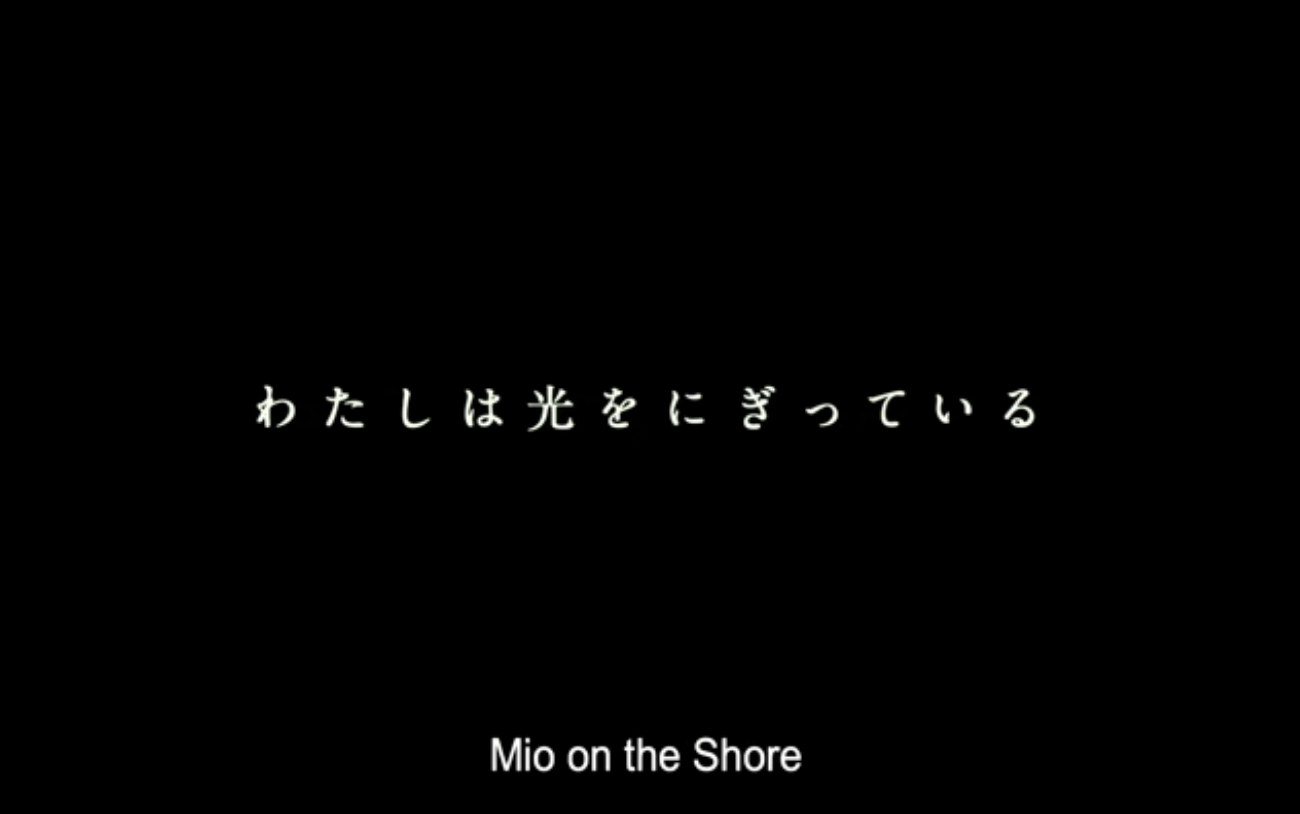
わたしは

Usually I find わたし written as 私. This is a pronoun to use for yourself. Like, “I”. There are many other pronouns that can be used (I personally use 僕(ぼく)). If you are interested in learning more about pronouns I recommend Game Gengo’s video.

If you are interested in how a pro translator translates pronouns look no further than Sarah Moon’s video.

    The は here suggests that the speaker is going to talk about themselves. As in “As for me”.

    I’ll just keep it a bit simple and go with “I” for now.

光(ひかり)を

Not that “Hikari”. But if you think of what her name (and her crest) stands for then you would be close. This kanji 光 means “light”. Considering we have an を particle after that, someone is doing something with that light. Let’s go on to the next word. 

にぎっている

As you can see from the conjugation, this is a verb. I do not know why they went with hiragana here but it is the verb “to grasp” or “to hold” called 握る. Think I’ll go with hold.

They then conjugated with the てーForm which makes into 握って.

And to make it an active verb (as in you are still doing that said action), you add いる to the end here. And voila you get 握っている. This turns the verb “hold” into “holding”. So someone is holding onto a light. This would literally translate into something like: 

“I’m holding on to the light” 

Seems like they are trying to hold onto something that gives them hope. This could be translated to “I’m holding on to hope”, but I think the point is getting across either way.

So in all we get:

“I’m holding on to that light”

Don’t know where they got the idea of Mio on the Shore but… okay? 

    This movie is about a young woman named Mio. She lives with her grandmother and runs an inn with her in Nagano. Due to her grandmother getting sick and having to go to the hospital to seek treatment, Mio has to go to the big city of Tokyo. Surely this would be something that someone her age would love to go. However, she’s very reluctant to go. Alas, she ends up staying with a friend of her father and starts working at his bathhouse.

    This movie was around the time where the Tokyo redevelopment plan was being put into action. And the bathhouse was in that district. This movie shows the characters simply living their lives while dealing with a situation they cannot do anything about. It is a slow burner type of movie but in my opinion it doesn’t need to be anything more than what it is.

    What sort of surprised me was the fact that Wit Studio had their hand in this movie. I guess they do films as well as anime.

    The movie also has a novel that was published about a week after the movie was released. Found it on Book Walker if you are interested.

    If you are interested you can watch the movie on Amazon.


救世の大冒険/KYUUSEI’S ADVENTURE

第8

お、空洞はここにあるか。入ったら、真っ暗だった。電光石火を使うように、ハナビをだしたが、やっぱ、まだ暗すぎた。だから、できるだけ見て回った。出かけたときに、でけぇ石で足元をすくわれた。あ!石じゃない。ポケモンだった。あのポケモンが怒って、攻撃し始めた。けど、ハナビが僕を守ってくれた。あいつの防御がやばかったぞ。掴むことはできるけど。名前はロック・リーだ。

という虫トレーナーと勝負した。キャタピーがイッパイいる。なんでそんなにたくさんいるの?コチョウはきっと全員倒すことができる。え?!なんやコラ?!ツナでけぇ。あいつは「ビードル」というポケモン。よっしゃ、コチョウは毒が得意みたいだ。僕達は勝ったとき、くんはリベンジマッチがほしそうだから、電話番号をあげた。この合図によって、31番道路にいる。新しいポケモンを掴まないと。それで、黒ずくめの男の話、キキョウシティが近いそうだ。

げ、イトマルだった。ホーホーがほしいのに。まあいいか。あいつの毒針は役に立つかもな。そういえば、コチョウはたぶん毒があまり得かないかもな。あとで、毒消しを使わなきゃ。ゲット!名前をなににしようかなあ。スパイダーマンが好きから、「ピーター・パーカー」のピーターでいい。

よし、ピーターは6匹目だ。少し間、訓練しとく。

8

Oh there’s a cave. I went inside and it’s pitch black. I let out Hanabi so she could act as a light source but it’s still too dark. I’ll look around as much as I can. When I was about to leave, I tripped over a rock. Ah! It’s a Pokemon. It got angry and started to attack but Hanabi protected me. This Pokemon sure can take a hit. Caught it and named him Rock Lee.

Fought another bug catcher named Wade. He sure does have a lot of Caterpie. I’m sure Kochou can take them all down. Eh?! What the heck is that?! It has a huge horn. It’s called a Weedle. Looks like Kochou has some resistance to poison. Sweet. It Looks like Wade wants to have a rematch so I gave him my number. From this sign, it looks like I’m on route 31. Better catch a Pokemon. And from what this guy in black told me, I’m close to Violet Town.

Oh it’s a Spinarak… wanted a Hoothoot but maybe poison sting can be useful. Guess Kochou doesn’t have resistance to poison. Better use an Antidote later. Gotcha! Now what should I name him? I like Spider-Man, so I’ll name him Peter.

Alright, I got 6 Pokemon now. I guess I’ll train up my Pokemon here for a bit.

In conclusion, I hope that this series is helpful with your journey to learning Japanese and/or taking an interest in the country’s culture. Until then… また来週!

PLAY-ASIA + キングダムハーツ +Pokemon Scarlet & Violet

日本語の練習 第133週

Japanese Practice Week 133

2022年06月12日「日」第133週 

Hello everyone! Starting off this week talking about my experience with Play-Asia. Going over the usual N3 stuff. Translating an article about the new Pokemon game with a few comments. Find out what a 天邪鬼 is doing in an anime called Dororo. Plus, watch Kyuusei get creeped out by some bugs in his journey through Johto.With that being said, let’s continue.

日本語のイベント/EVENT IN JAPANESE

「PLAY-ASIA」という取り扱っているゲームショップサイトは日本からゲームを買うことができます。ギフトカードも買えます。日本語を勉強したら、このサイトは僕のおすすめです。

大学で日本語を勉強してるとき、日本語ができる男を会いました。僕は彼に「どうやってうまくできるのか」と聞いました(やはり、英語で聞いました)。答えは「キングダムハーツをやる」。それだけです。ゲームしたばかりでした。あのときさえイマージョンのことを考えなかったです。そして、このブログでキングダムハーツを翻訳したり、「Paradigm Shifter」の実況を見たり、日本語を説明するあと、日本版のキングダムハーツをやっと買いました。

PLAY-ASIA に初めて注文を出して荷物が無事届きました。22日かかりましたけど、ついに来てよかった。


N3 文法

[その結果]

as a result

You can use this grammar to state something that you or someone else has done. Then you can express result of that action in another sentence or phrase after it.

Sentence 1 + その結果 + Sentence  2

Ex: 彼は家を掃除せず、一日中ゲームばかりしていましたその結果ゲーム機を禁止された。

(He played video games all day without cleaning the house. As a result, he got his game console taken away.)

Ex: これ以上はやりすぎたらその結果どうなるかも見越したのか?

(Did you foresee the consequences (the result) if you take it that far?)

[そうもない]

very unlikely to

Use this when you think that something absolutely won’t occur.

V[drop ます] + そうもない

Ex: この状況は楽しくなれそうもないけど、やるしかないなあ。

(It’s very unlikely this is going to be fun but, I have to do it.)

Ex: 被疑者の中に、「あいつ」なんていりそうもないけど、真犯人をあふりだす手掛かりを見つかないと。

(Among all the suspects, it’s highly unlikely for “them” to be the culprit. However, I have to find a clue that will lead me to the true culprit. )


N3 動詞/N3 VERBS

招待する
しょうたいする
To invite

招=beckon, invite, summon, engage
待=wait, depend on

This verb is an invitation for someone to be a guest to a location or an event. I like to think of this as someone waiting or anticipating someone to reply to their invite. It has the nuance of making a request to someone to go to something. Like a wedding or in the case of Nisekoi: a party.


記事を読もう/LET’S READ

新たなポケモン公開で話題 伝説のコライドン&ミライドンら5匹「かわいい!」「ド派手」

On the first of this month, new information about the new addition to the popular game series “Pokemon” , “Pokemon Scarlet & Violet” for the Nintendo Switch has been announced. The announcement came with the game’s release date November 18th and a few designs of the Pokemon you will encounter. When the new Pokemon were revealed, the internet commented on how cute and cool they are.

The new Legendary Pokemon in this game are Koraidon and Miraidon. You can meet Koraidon or Miraidon in Scarlet and Violet, respectively.

Besides these Legendary Pokemon, 3 new Pokemon were revealed. The electric type mouse Pokemon Pawmi, the normal type pig Pokemon Lechonk, and the grass/normal type olive Pokemon Smoliv.

The reactions on the net were things like “I’m hyped for this! I’m gonna get Miraidon!!”, “The legendary Pokemon sure do look flashy!” and “Hey, which one is everyone going to buy? I really like Koraidon”.

A new gen Pokemon game hasn’t been released since Pokemon Sword and Shield 3 years ago back in 2019. With this new game, it will be the series first ever open, richly rendered world where trainers can freely explore, and enjoy encounters with Pokémon and people they have not yet seen.

The three new starters that will join trainers on their journey first will be the grass cat Pokemon Sprigatito, the fire crocodile Pokemon Fuecoco, or the duckling Pokemon Quaxly.

It’s been a while, so here are some comments:

k_t:
I was a bit surprised to see that it was 3 years between the first gen and gold/silver. Felt longer than that.

It’s probably because I got hooked on the first gen and was anticipating the release of gold and silver while reading about it in Corocoro back then.

My mother pre-ordered it and let me get it as an early birthday present. I recall riding on my bike with the game in the basket rushing to get home to play it.

Wish I could have that excitement again…

koj:
Don’t see a reason to buy it. Wonder if we’ll be able to use Dynamax, Mega-Evolutions, and Z-Moves like we can in ranked matches.

It’d be great to use all of them with new animations.

真冬のクリスマスにタケノコ掘りする人 (A person digging for bamboo shoots on a mid-winter Christmas):
If you look closely, it looks like Koraidon has a motorcycle wheel in it’s chest. While Miraidon has a spaceship like design.

Wonder if they’ll change into some kind of vehicle when they change form.

rzv:
Koraidon/Ancient
Miraidon/Future
With that pattern the third Legendary should be…
Imadon

right?


Those were some interesting comments. That one username about the bamboo shoots are hilarious. Looks as if fans have some high expectations with this one. I don’t know if they’ll be able to put all those new evolutions and features from other games in this one.

But wow! An open world Pokemon game. I guess Arceus was the bridge for that.

The localization for these new Pokemon names are awesome. Never thought I’d see chonk and smol in Pokemon names XD. It is great that they kept the legendary Pokemon’s names alone. Seems like we’re going to have a battle between eras with this one.

Considering it’s my favorite color, I’m definitely going with Scarlet.

November 18th… I’m looking forward to that. Hopefully you are as well.


対話/DIALOGUE

The time has come… to play Kingdom Hearts in Japanese!

[ついに来た]

ピンポン

A:あれ?誰?ね、イズミ。あたし、手がいっぱいだから。ドアを。

B:いいよ。

A:あ、郵便屋だったか。これって何?

B:これ?僕の小包だよ。ずっと前から待ってた。

A:やっと来てよかったね。何を買ったの?

B:キングダムハーツIII。

A:え?発売したとき、買ったと思ったっけ?

B:買ったけど、日本語ですることができなかったから、これを買った。

A:へー、そうなんだ。キングダムハーツは人気なのに、言語を代わることができないなんて、変でしょう。

B:だよね。まあいいけどさ。二人でプレイして見ない。

A:いいよ、ドナルドがソラを回復したら、交代しようよ。

B:レベル1実況しないか。

A:やりすぎない。

B:あ、確かに。こんなゲームするなんて、引っ指しぶりだから、とりあえず、遠慮しとく。プラウドモードでいい。できるの?

A:楽勝だ。

[It’s finally here]

Ding-dong

A:Huh? Who’s that? Hey, Izumi. I have my hands full. Can you get the door?

B: No problem.

A:Oh, it was the mailman. What’s this?

B: This? It’s my package. I’ve been waiting for it for a long time.

A: It’s good that you finally got it. What did you buy?

B: Kingdom Hearts III.

A: What? I thought you bought it when it came out?

B:I did, but I couldn’t play it in Japanese, so I bought this.

A:Oh, I see. Kingdom Hearts is so popular, it must be weird not to be able to switch languages.

B: I know, right? Well, it’s fine, though. Wanna play..

A:Sure, if Donald heals Sora, we’ll switch.

B:Let’s do a level 1 playthrough.

A:Isn’t that overdoing it?

B:Oh, you got a point. I haven’t played a game like this in a while, so I’ll pass on that for now. I’ll just go with Proud Mode. Can you keep up?

A:It’ll be easy.


タイトルを見る/WHAT’S IN A TITLE

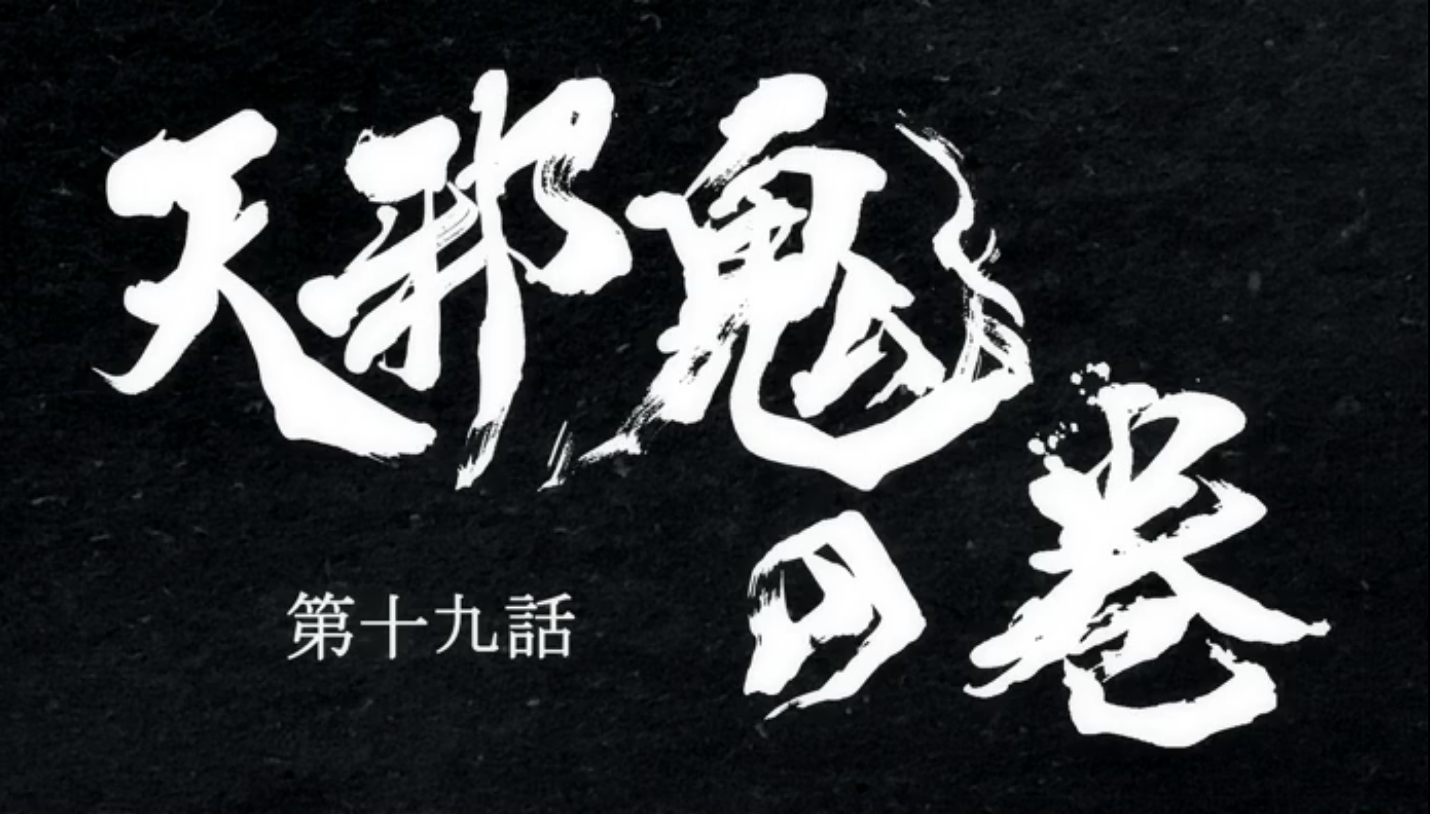
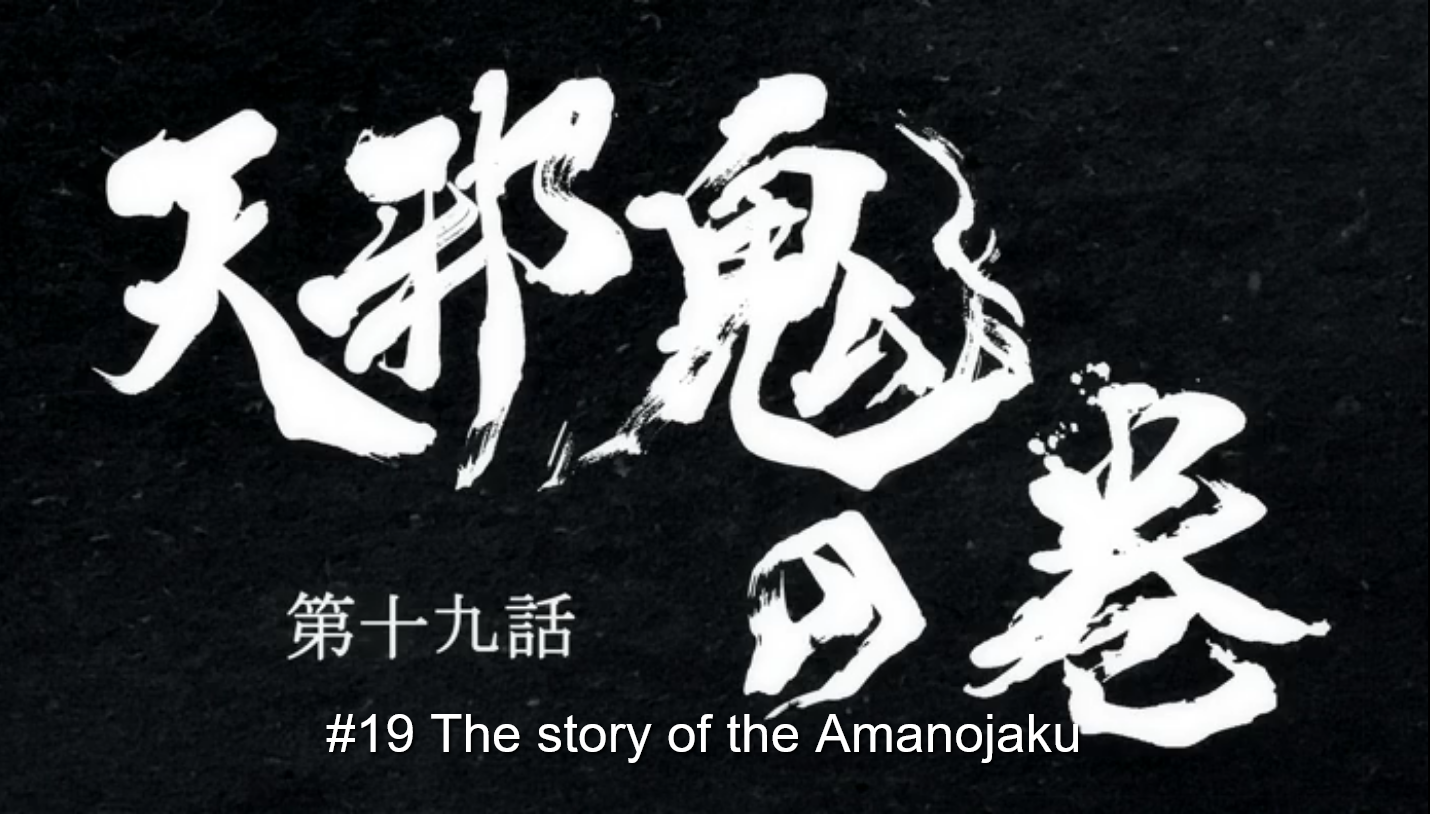
第十九話
天邪鬼の巻

第(だい)十九(じゅうきゅう)話(わ)

Just your typical episode counter. This is Episode 19 from the show.

天邪鬼(あまのじゃく)の

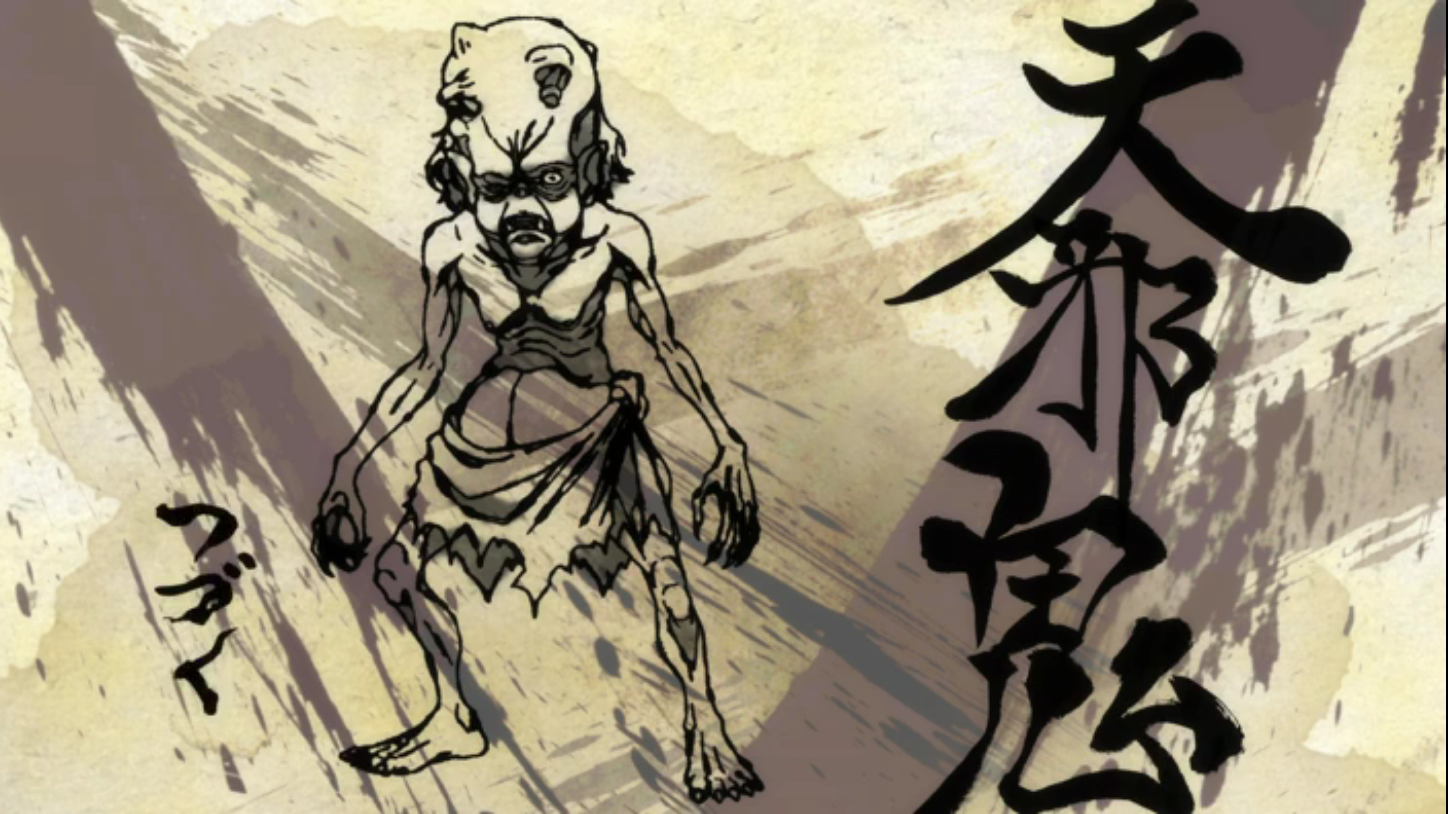
If we separate each kanji we get something like heavenly (天【あま】)evil (邪【じゃ】)demon (鬼【く】). I think I will go with Amanojyaku here.

This is a name of a yokai. From what I gleamed from there, these yokai are known to make humans act upon their wicked desires that are buried deep within their hearts. However, in this episode it makes everyone say the opposite of what they truly want to say.

The の is just a particle that connects to the next word. It’s most likely going to be given a possesive (Amanojyaku’s) or used as a descriptive (The ____ of Amanojyaku).

巻(まき)

When I see this kanji it makes think of the counter for books 巻(かん). It also makes me think of the verb 巻き込む to roll up or get someone involved in something. Considering this anime has a self contained story in each episode, I think it would be best to go with something like story or tale.

Yeah, tale sounds like a good idea. We are talking about a yokai from Japanese folklore, so why not.

Episode 19
The Tale of the Amanojyaku

Good. This title comes from an anime called Dororo. It is a tale about a boy taking back his body from the demons his father struck a deal with to make his land prosper. Yes another “Dad of the year” in the making here (and just before Father’s Day). This boy grows up and fights these demons with blades for arms. As he goes on this journey, he soon meets a kid named Dororo (title drop).

Together they go on quest to retrieve Hyakkimaru’s body. However, when Hyakkimaru get’s a part of his body back from the clutches of the demons, it doesn’t bode too well for his father’s land. Let’s just say a family reunion occurs of some sort.

If you are interested in the anime, you can find it on Amazon Prime.

And if that paragraph wasn’t enough to persuade you, here’s a PV:


キュウセイの大冒険/KYUUSEI’S ADVENTURE

第7

夜に別のポケモンが出てきそうだなあ。きもい虫ポケモンというイトマルと戦った。かっこよさそうなポケモンというホーホーを発見した。ここでコウチョウを掴んだから、ホーホーをゲットできへん。別のところにいるかなあ。ポケモン図鑑によると、出来そうみたい。

あかん!このイトマルめ!シノブを毒されやがった。あれ。。。4歩ごとにシノブの体力が減ってしまった。このままじゃ、ポケモンセンターに行けるなんて、無理。あ、そうだ!毒消しが持てたぞ。毒消しをあげてシノブは大丈夫だった。これがあってよかったわ。フレンドリーマットで毒消しを買いに行くかも知らへん。よーし。訓練はもう終わりだ。

虫が好きな男と勝負した。ハナビは火タイプの技を覚えればいい。きっと、こんなタイプのポケモンの弱点があるはずだ。トリヤマの飛行タイプの技であいつを倒せるかも。けど、とりあえず、こんな技を覚えるなあ。あれ?あかん。。。母ちゃんだ。え?言わずに出かけたことを怒ってへん?貯金する?僕の?役に立つかもしれないから、それをさせとく。

7

It turns out different Pokemon show up at night. Fought this creepy looking bug Pokemon called Spinarak. Found this cool looking Pokemon called Hoothoot. I caught Kochou here, so I can’t catch it. Maybe I’ll be able to find it somewhere else. According to Pokedex, it looks like I can. 

A Spinarak poisoned Shinobu. Wait… every step I take hurts her?! I can’t get to a Pokemon Center like this. Oh, that’s right. I have an antidote. Gave it to her and she was fine. Thank goodness I had that. Maybe I should buy some at the Mart next time. Alright, that’s enough training. 

We fought this kid who likes bugs next. If only Hanabi knew a fire type move. Pretty sure that’s their weak point. Maybe Toriyama could take them down with a flying type move when he learns one. Eh? Oh shoot it’s mom… eh? S-she’s not mad that I left without saying anything. She asked if I wanted her to save some money for me. That might come in handy so I’ll have her do that.

In conclusion, I hope that this series is helpful with your journey to learning Japanese and/or taking an interest in the country’s culture. Until then… また来週!

Kanazawa Shogi

日本語の練習 第132週

Japanese Practice Week 132

2022年06月05日「日」第132週 

Hello everyone! Starting off today talking about the shogi app called Kanazawa Shogi. Then we’ll jump right into some grammar and a verb. And before we get into what Kyuusei is doing in Johto, I’ll introduce you to a manga I’ve been reading.

So, with that being said, let’s continue.

日本語のイベント/EVENT IN JAPANESE

最近、将棋をしました。小心者向けの本を読んだり、詰将棋をやったり、「金沢将棋」というアプリを使っています。このアプリを通じて将棋を上達させたいんです。コンピューターレベル300までに上げることができます。こんなレベルなんて、今の僕として、無理ですから、春末にレベル5だけに勝ちたいと思います。よかったら、この動画を見てください。


N3 文法

[せいで / せいだ / せいか]

V[Plain Form] + せいで / せいだ / せいか
いーAdj+せいで / せいだ / せいか
なーAdj+な+せいで / せいだ / せいか
N + の+せいで / せいだ / せいか

because of

It is somewhat similar to おかげで but it is used to say something is done by someone and it ends up being bad outcome. In other words, expressing that something is someone’s fault.

Ex:考えすぎるせいか、謎が全然解けない。

(I can’t solve this mystery because I’m overthinking.)

Ex:気温が高いせいでアイスが溶けちゃった。

(Because it was hot, the ice cream melted.)

Ex:いろいろなせいで、宿題に集中できない。

(Because of so much going on, I can’t focus on my homework.)

Ex:強いトレーナーのせいで、ジムバッジをもらえなかった。

(I couldn’t get the badge because the trainer was too strong)

[しかない]

have no choice but

There are a few ways this grammar can be used

V[Dict Form] + しかない
N + しかない

Similar to だけ but this grammar can be used to express hopelessness of a situation.

Ex:試験に落ちたから、やり直すしかないんだ

(I failed the exam, so I have no choice but to retake it.)

Ex: 君にとっては、これはただのゲームでしかないかもしれないが、僕にとっては大切な思出ですよ。

(This might just be nothing but a game to you, but it holds a lot of precious memories to me )


N3 動詞/N3 VERBS

証明する
しょうめいする
To prove; To verify; To certify

証=evidence, proof, certificate
明=bright, light

I like to think of this word as saying “show me (shou mei) the evidence”. Think of the evidence shining light on the truth.


対話/DIALOGUE

Finding a way to pass the reading section on the JLPT sure can be tough.

[読書力を上達なんて、難しいね]

A:ねえ、ユキコさん、ちょっといい?

B:どうしたの?

A:最近、N3の試験の勉強をしているけど、文法とリスニングは大丈夫だが、読書力は下手だ。読書力があまり上手じゃない。おすすめの本があるのか?

B:それなら、「とびら」という教科書とか「新・完全マスターN3」がいいと思う。

A:新幹線N3って、よく聞いてたが、あの教科書を聞いたことない。

B:え、そうなの?今まで何を使ったの?

A:別に何もない。漫画、小説、記事などを読む。ほら、今の本を読んでる。

B:あれ?

A:なんだ、こんなストーリー気になる?

B:うん。だけど、そっちはない。これって、難しそうだし。どんな記事を読んでるの?

A:科学、プログレッシブ、コンピューターの記事しか読まない。

B:こんな複雑な記事を読むことが出来るの?

A:まあ、一応。

B:色々なことを読んだ方がいいと思うよ。

A:何が?

B:一般的なことの方がいいと思うよ。たとえば、メールとか、日常系の記事とか、レター。

A: あ、全然考えてなかった。やってみる。ありがとう、ユキコ。

[It’s really hard to improve reading]

A:Hey, Yukiko, can we talk for a bit?

B:What’s up?

A:I’ve been studying for the N3 exam lately, and my grammar and listening are okay, but my reading skills aren’t very good. Do you know any books that can help me?

B:I think the “Tobira” textbook or “Shin Kanzen Master N3” would be good.

A:I’ve heard a lot about Shin Kanzen, but I’ve never heard of that textbook.

B:Oh, really? What have you used so far?

A:Nothing really particular. I read manga, novels, articles and stuff like that. Take a look, this is what I’m reading now.

B:Huh?

A:What, are you interested in these kinds of stories?

B:Yeah, I am. But that’s not one I’m getting at here. This one looks too difficult. What kind of articles are you reading?

A:I only read science, programming, and computer articles.

B:Can you read such complicated stuff?

A:Well, more or less.

B:I think you should read about a lot of different things.

A:Like what?

B:You know, like more general things. For example, emails, daily articles, letters. Stuff like that.

A: Oh, I hadn’t thought of that at all. I’ll try it. Thanks, Yukiko.


タイトルを見る/WHAT’S IN A TITLE

愚かな天使は悪魔と踊る

愚(おろ)かな

This is a なーAdj that is used to give a description to the following word. The kanji 愚 can mean foolish, folly, absurdity or stupid. I’ll go with foolish for now. I’m currently watching the original Digimon Adventure 01 and Devimon says this quite a bit. Speaking of Digimon…

天使(てんし)は

We have covered this word in another タイトルを見る here. Here’s what was stated:

This noun is made up of the kanji which can mean heaven (天). The second kanji looks familiar. It is used in the verb to use or 使う. However, in this case, something like “user of heaven” doesn’t seem to fit.

So here are other meanings for 使 other than use: messenger, envoy, ambassador. Hmm someone that is an envoy or something of the like from heaven. That’s gotta be an “angel”. No Evangelion pun intended of course (speaking of Eva. Finally watched the last movie on Friday, it was great.). 

So we have a “foolish angel”.

悪魔(あくま)と

When I see the first kanji I think of the word 悪い which usually weans wrong or bad. And that’s not too far from the kanji’s many meanings: bad, vice, rascal, false, evil, wrong.

As for the second kanji 魔 I think of 魔法少女 or magical girl. There is also a word for witches called 魔女. This kanji has a few meanings such as witch, demon, evil spirit.

Considering we are dealing with a “foolish angel”, it would make sense to translate this to “devil”. But I’ve read the first volume of the manga and can say that the main character works as a “demon slayer” of some sort. So perhaps “demons” would be a better choice.

But what about the と there? If we look at our next word, we see it is a verb. Which gives us a sign that it can’t be the “and” particle. So the angel must be doing something “with” the demons. We’ll find out what in the verb below.

踊(おど)る

The kanji 踊 can mean jump, dance, leap or skip. I think it is safe to say this verb is “to dance”. So the final translation would be:

The Foolish Angel Dances with Demons

There’s not an official title just yet for this manga in English, so I can’t check this one against someone else’s translation.

The story starts off about a devil coming to the human world. For the sake of his world being in peril by the angels and loss of morale in his comrades, he is ordered to find someone with a lot of charisma. Luckily as soon as he enters high school, he finds that charismatic person. Unfortunately… turns out she is is mortal (immortal?) enemy, an angel.

While I was reading the first chapter, I was wondering why people were comparing it to one of my favorite manga, Kaguya-sama, but after finishing the first volume I can kinda see why.

Considering how good the premise and art is, I’m sure it will get picked up for translation soon. Heck it might even get an anime adaptation one day. In the meantime, I think I’ll keep reading it on BOOK★WALKER.


救世の大冒険/KYUUSEI’S ADVENTURE

第6

30番道路についたとき、キャタピーは草で飛び出した。ハナビのたいあたりの技であいつをぶつけて、僕が掴んだ。しのぶもうあるから、このあだ名はダメだ。「鬼滅の刃」を観ているから、彼女のニックネームは「こちょう」。

目の前に、トレーナーがいるみたいだな。強いかどうかわからないが、チームを回復しとく。あとで、モンスターボールを買う。

よし、このルートで初めての勝負だ。彼は僕が弱いと言った。失礼だな。僕たちの力を証明する!ハナビはえんまくの技とたいあたりの技を攻撃し続けて、相手のポケモンが倒れた。あとで、僕の電話番号を聞いた。まあ別にいいけどさ。今度で、1匹とか2匹を掴んだ方がいいよ。また彼と勝負するのが楽しみだ。

つぎ つぎ。ポーポーがいるのか。よし、こちょうに頼むぞ。こちょうは疲れそうだから、相手のコラッタはトリヤマに任せて。え?!トリヤマは覚える技。。。1だけ?!たいあたりの技だけかよ?!あかん!あのコラッタのしっぽをふる技がトリヤマの防御力をだんだんさげる。ハナビに入り替えた。僕たちの勝利だが、戦ってるポケモンは大変疲れそうになった。これはやばいへん。キキョウシティに着く前に、チームはもっと強くなりたい。

6

When I got on Route 30, a Caterpie appeared. Hanabi tackled it and then I caught it with a pokeball. I already named my Rattata Shinobu and I’ve been watching Demon Slayer, so I’ll name her Kochou.

Looks like there are some trainers up ahead. I don’t know if they are strong or not but I think I will heal up my team first. While I’m at it, I’ll buy some pokeballs.

Alright my first pokemon battle on this route. And he thinks I’m weak. We’ll prove our strength. Bombarded with smokescreen and Hanabi took it out with a few tackles. After the battle, he asked for my number. Sure why not. Sure hope he gets more Pokemon. I’m looking forward to our rematch. 

Onto the next match. I think I’ll let Kochou fight this Pidgey. Kochou looked tired after that fight, so switched to Toriyama to handle his Rattata. He only knows how to tackle?! That Rattata’s tail whip move is chipping away at his defense so I had to switch to Hanabi. We won but now everyone that fought is tired. I should probably train some before heading to Violet Town.

In conclusion, I hope that this series is helpful with your journey to learning Japanese and/or taking an interest in the country’s culture. Until then… また来週!

Birthday + Goals + Japan Becomes #1

日本語の練習 第131週

Japanese Practice Week 131

2022年05月29日「日」第131週 

Hello everyone! Kyuusei here to teach you Japanese and show what I find interesting about Japan. With that being said, let’s continue.

日本語のイベント/EVENT IN JAPANESE

レベルが29に上がった!3年前から、日本語を勉強し続けて、このブログをはじめました。来年、どこかにいるのかはわかりませんが、日本語系の仕事をしたいと思います。翻訳者とか、ゲームを作るとか、日本語の教師とか。日本語を勉強したら、色々な場所に行くことができると思います。色々な場所、色々な扉。

でも、日本語はまだまだです。もっとうまくなりたいから、はやくN2かN1に合格したいですが、今の調子で続ける予定です。それに、今の僕がN2に合格するなんて、ありえないことです。難しくても、あきらめない予定です。毎日、本を読んだり、書いたり、ゲームをしたり、翻訳したり、話したりしたら、きっといつか目指すゴールに届くことができます。 


N3 文法

[さえ~ば]

if only… then/As long as

V[drop ます]+さえ+すれば / しなければ
いーAdj[drop final い] +さえ+あれば / なければ
なーAdj+でさえ+あれば / なければ
N+さえ+V(Conditional form)

This boils down to if a condition is met, then that is enough. You don’t have to do anything else. 

*When using the negative form(ばない) of this it means the condition has not been met. In other words it is not enough.

You can see this same grammar being used in the title for this anime here.

妹さえいればいい

Ex:さ、小五郎オッサン、推理の時には、コナン君に任せさえすればよい
(Alright Kogoro, while doing the deduction, all you have to do is leave it to Conan.)

Ex:とても忙しくさえなければ、日本語の勉強を続けたいと思っています。
(As long as I’m not too busy, I think I’d like to continue studying Japanese.)

Ex:こんな簡単でさえあれば、早くするべきでした。
(If it was this easy, then I would’ve done it as fast as possible.)

Ex:勇気さえあれば、来年、日本に行きます。
(If I had the courage, I’d go to Japan next year.)

[最中に]

in the middle of

V[てform] + いる最中(に)
N + の最中(に)

This grammar is similar to 中に (while doing something). However, 最中に is used when you are right in the middle of doing something.

Ex:ラスボスを倒している最中に、停電しました。
(There was a blackout when I was in the middle of beating the last boss.)

Ex:本棚で本に並んでいる最中に、頭に本が落ちていく。
(I was in the middle of organizing the bookshelf when a book fell on my head.)

Ex:キーブレード戦争の最中に、「なんでカイリが。。。」と言ってしまいました。(During the Keyblade war, I said “Why Kairi…”)

Ex:おい、今は食事の最中だから、スマホを使わない方がいいですよ。
(Hey, we’re having dinner so you should not use your phone.)


N3 動詞/N3 VERBS

使用する
しようする
use; application; employment; utilization

使=use, send on a mission, order, messenger, envoy, ambassador, cause 
用=utilize, business, service, use, employ

You may have seen this verb’s first kanji in another verb called 使う which also means to use. But what is the difference between the two verbs? They have the same meaning however, 使用 is used more in a polite setting. Like a business or talking to a customer. 

As you can see from the first example, it has a meaning of to take advantage of something intangible like an opportunity or in this case the fruits of someone’s labor.

This verb can also be used as a noun. It can be used to mean to apply something or utilize it to your advantage. Like how a skill can be improved through repetition (反復(はんぷく)) or in this context since they are talking about games “grinding”.


記事を読もう/LET’S READ

観光きたい 日本めて1になる

Japan Becomes #1 Country People Would Like to Visit for the First Time

Every two years since 2007, an organization called the World Economics Forum researching a releasing the results of countries and regions people would like to go visit. This year, among 117 countries and regions, Japan came out on top.

With it’s convenient transportation, splendid nature and culture, and the security while sight-seeing makes for a few reasons why Japan became number one.

The countries that took 2nd to 10th place were America, Spain, France, Germany, Swiss, Australia, Britain, Singapore, and Italy, respectively.

The organization stated “Due to the Corona Virus, we understood that tourism is an important aspect in the world’s economy. Countries around the world must make it safe for people to be able to visit.”


Love to see Japan take the first spot in these results. I don’t blame anyone who wants to go there. Especially considering the Olympics were held there last year. Hopefully the pandemic situation gets better so that more people can do some traveling.


対話/DIALOGUE

Two sisters wonder what to get their brother for his birthday.

[姉妹]

A:そろそろあんちゃんの誕生日ですね。何が欲しいのかなあ?

B:毎年、クリスマスとか誕生日とか弟に聞きますが、全然わからないってじゃん。

A:きっとほしいものがあるはずだよ。

B:そうよ。でも、毎年、全然言わない。ムカつくこの弟わよ。

A:そうだね。

B:今年もアマゾンギフトカードあげるかも。

A:あ、わかった。

B:なに。

A:きっと、あんちゃんはアマゾンで欲しいものリストがあるはずだよね。だったら。。。

B:あ、考えなかった。アナイアは天才。

A:ともかく、聞いていくよ。

B:もうメールした。

A:はやっ。いつもまにか?!

B:あたしの親指の速さをなめないでよ。あ、返事した。

A:なになに?

B:あるよ。それじゃあ、これを買う。

A:じゃあ、あたし、これを。

[Sisters]

A:It’s almost big bro’s birthday. Wonder what he would want?

B:Every Christmas and birthday I ask him but he never knows.

A:Surely there’s something he wants.

B:Yeah. But, he never tells us. Such a frustrating little brother.

A:I know right.

B:I guess I’ll get him an Amazon gift card.

A:Oh, I got an idea.

B:What?

A:Surely, big bro has a wish-list on Amazon right? So then…

B:Ah, I didn’t think about that. Aniyah, you’re a genius.

A:Anyways, let’s ask him.

B:Already messaged him?

A:That was fast. When did you-?

B:Don’t underestimate the speed of my thumbs. Ah, he replied.

A:What does it say?

B:He has one. Then, I’ll buy this.

A: Then, I’ll get this for him.


タイトルを見る/WHAT’S IN A TITLE

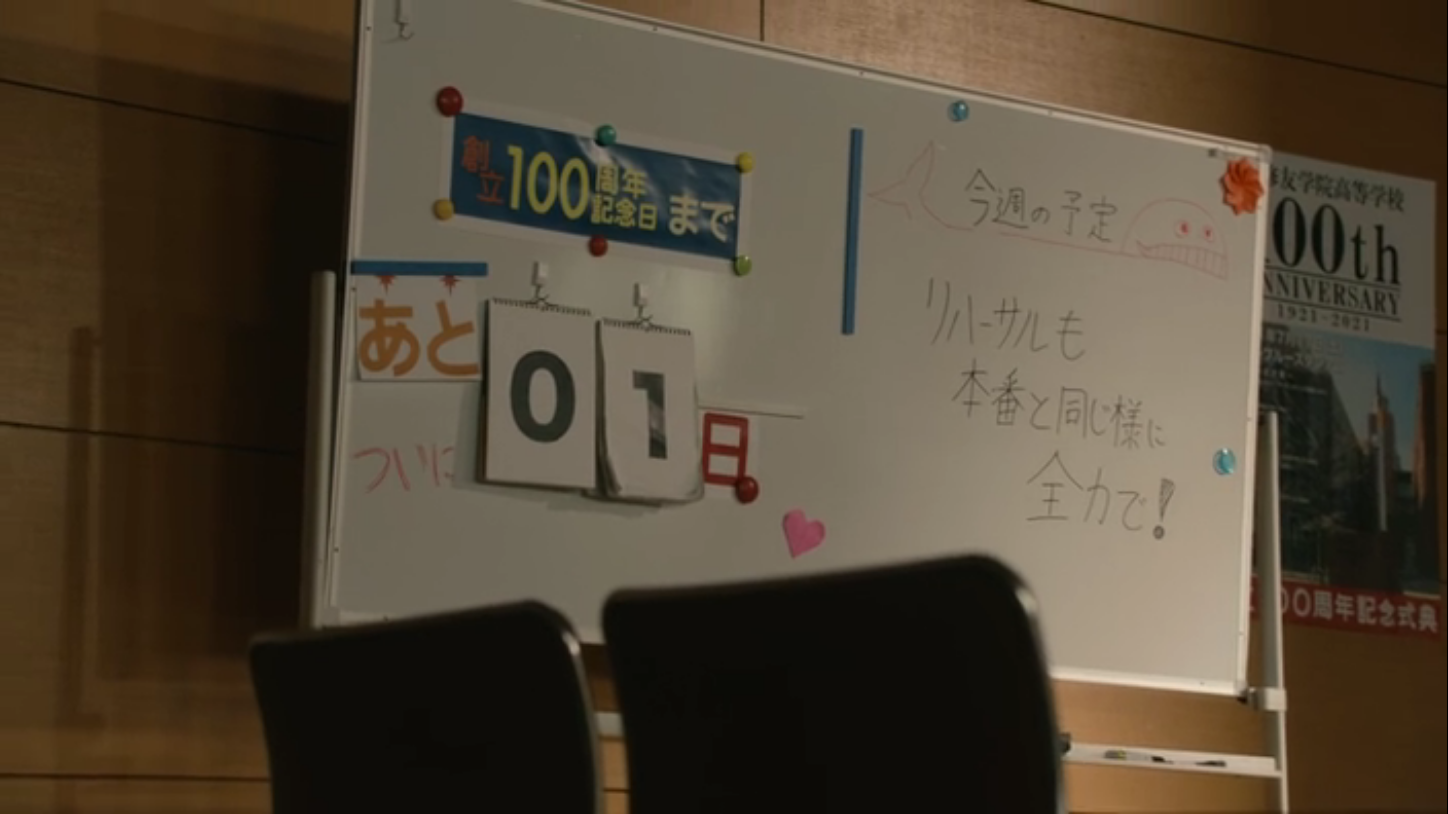
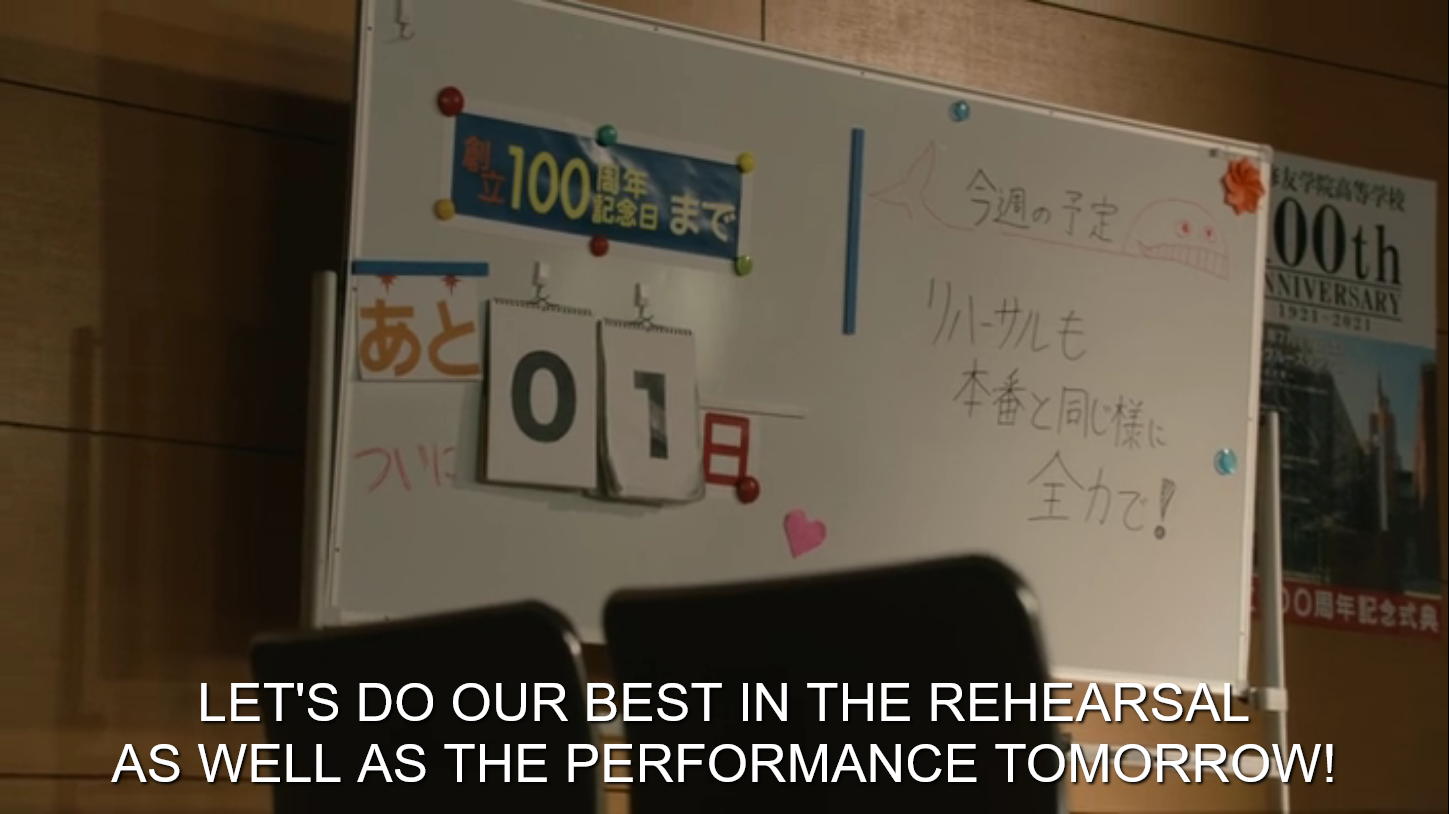
今週の予定
リハーサルも
本番と同じ様に全力で❢

今週(こんしゅう)の

I like to think of this word separated by it’s kanji. 今 means now while 週 means week. So the week that we are in right now. Sounds like “this week” to me. We’ll get back to の once we see the next word.

予定(よてい)

The first kanji can mean beforehand while the second one can mean determine, fix, establish, decide. So you are deciding something beforehand? It makes sense that this word has something to do with planning and intending to do something. Considering this seems to be some anniversary event, I think it would be best to go with “schedule”

Now that we have this word figured out, it is safe to say that the の particle is connecting “This week” and “schedule” together by adding possessiveness to week (making it week’s). I’ll translate this part as “This Week’s Schedule”.

リハーサルも

リハーサル is a loan word that means “rehearsal”. The particle も here gives it a feeling that the people holding this event plan to have the same quality with the actual event. We’ll need a bit more info to complete this translation though.

本番(ほんばん)と

本番 has many meanings but considering we are dealing with an event of some sort, it is best to go with “performance”. The と particle is most likely connecting with the next word with an and.

同じ様(おなじよう)に

The kanji 同 in 同じ can mean the same and that puts us on the right track. As for the next kanji you may be familiar with it. It is used as a honorific for someone’s name. Like かぐや様. It does have another meaning and that is state, situation or manner. So in all, this なーAdj 同じ様 means “same state”. In other words, they seem to want to handle the performance the same way they are doing rehearsal.

When a なーAdj is put together with に, the word itself is being turned into an adverb that describes how they are going to handle this rehearsal.

So as mentioned above, they are going to [verb] the rehearsal and the actual performance the same way. But what could that verb be… well…considering this is a group doing this I feel as though there should be some unity here. Like “let’s do this”.

全力(ぜんりょく)で

We have the kanji 全 which can mean all and the kanji 力 which can mean power. Together this word gives you a feeling that someone is going to give something there all. And the で particle here indicates a means of action.

So as noted before, the ones holding this rehearsal and the performance intend to give it their all or give their best effort to make it a success.

So in all, I would translate this to:

“This Week’s Schedule”
“Let’s give it our all in the rehearsal and the performance”

Left side: Days until 100th Anniversary (finally) 1 more day

Very close to their translation. I do like how they brought 同じ様 into their translation: “as well as”. I decided to just go with and to connect the two. Nonetheless…

This title is from the film “Homestay“. It is about a person getting a second chance at life in a new body: a high school boy named Makoto. But there is a catch. To keep the body, they must find out why the person died. There is also a deadline of 100 days which conveniently matches up with this event their school is holding.

It has a nice mystery element while also having a drama unfold as the true story of Makoto’s death is revealed.

I enjoyed the movie very much. If you’d like to check it out, it’s on Amazon Prime. If you are into anime, you can find the anime adaptation by the name of “Colorful”. These two films are based on the Mori Eto’s book by the same name as the animated film. One day I hope to read it on Bookwalker but if you are if you are interested, then you can find it here.

Here’s a trailer for the live action film:

And a PV for the animated movie:


キュウセイの大冒険/KYUUSEI’S ADVENTURE

第5

段差に飛び込んで、ワカバタウンに帰った。誰かがポケモンを盗んだ?!お巡りさんは彼の姿を教えてもらった。ちょっと。。。長い赤紙。。。やばっ。。。啓二のやつか?!お巡りさんに彼の名前を教えてあげて、お巡りさんが出かけた。それで、博士に卵を見せた。あのとき、博士はワクワクして、話していた。まあ、少しだけスルーしとく。

終わったみたいで、博士はばかばかしいことを言った。え。。。僕。。。チャンピオンに?オーキド博士からポケモン図鑑をもらったとしても、そんなことはあり得ないだろう。だが、Lanceとかレッドになったら、ポケモンリーグを目指すなんて、いいかもなあ。最初のジムはViolet Town。よし、まっすぐに行く。研究者は僕にモンスターボールをくれた。これで、ついにポケモンをゲットだぜ!よしゃ!博士は何か言ってるが、聞こえなかった。出かけちゃった。

最初のポケモンをゲットする時が来たぞ。29番道路に行くと、ポケモンの掴み方を教えているトレーナーがいた。だが、断る!自分でしたい。ポケモンを掴むって、難しくないじゃん。ポーポーが飛び出した。強そうだなぁ。でも、ゲットだぜ!男だから、あだ名はトリヤマに決めた。

46番道路でコラッタを掴んだ。彼女のあだ名はしのぶ。

#5

Jumped over a few ledges and made it back to New Bark Town. So someone stole a Pokemon?! The cop described him to me. …wait… long, red, hair… oh crap…it was that guy named Keiji?! Told the cop his name and he left. Showed the professor the egg and he started talking excitedly. I’ll just tune him out for a bit. 

Sounds like he’s done. Wait, me… become champion. Just because I got a Pokedex from Prof. Oak doesn’t mean that’s possible. But if I can become like Lance and Red, then I guess I can aim for the Pokemon League. So the first gym is in Violet Town. Alright I’ll head there. His assistant gave me some Pokeballs so I can finally catch some Pokemon. Alright! The professor was saying something but I ignored him and left.

Alright time to catch my first Pokemon. I went to Route 29 and there’s a trainer here who wanted to teach me how but I want to figure it out on my own. I mean how hard can it be? A Pidgey appeared. It looks strong. But I caught it. It’s a guy so I’ll name it Toriyama.

Caught a Rattata on Route 46. I’ll name her Shinobu.

In conclusion, I hope that this series is helpful with your journey to learning Japanese and/or taking an interest in the country’s culture. Until then… また来週!

Tokyo School Life + What is 当て字?

日本語の練習 第130週

Japanese Practice Week

2022年05月22日「日」第130週 

Hello everyone! Talking about a game that I’ve been playing this Spring called Tokyo School Life. Providing some grammar and a breakdown of a verb as usual. We will also be getting into a title from Vinland Saga. And to wrap it up Kyuusei has a battle with his rival. With that being said, let’s continue.

日本語のイベント/EVENT IN JAPANESE

今月、「Tokyo School Life」というゲームをクリアしました。このゲームのストーリーは計3ルートに分岐する方式が取られていますが、最初から、ルート一つだけクリアする予定でした。結局、全部をクリアしてしまいましたw。15話あります。第10話では、ルートを選ぶことができます。そして、それぞれの女の子にはエピローグがあります。

これで日本語、文化、などのことが勉強になりました。フリガナもあります。しかも、バイリンガルテクストゲームです。すなわち、日本語とか英語とかを勉強するなら、これでいいと思います。

「Tokyo School Life」は安いゲームです。SteamとSwitchでプレイすることができます。

たぶんこれを読んでいる人は僕に「ストーリーの事をどう思うか」って尋ねてほしそうですね。じゃあ、プログレスリポートを楽しみにしていてほしいです。


N3 文法

[っぽい]

 -ish, -like

V[drop ます] + っぽい
Noun + っぽい
いーAdj (drop final い) + っぽい
なーAdj + っぽい

This grammar acts as a suffix to mean that someone has the characteristics of something when it is a noun or an adjective.

In the case of verbs however, it gives the idea that the action taking place can be easily seen. 

The っぽい grammar also acts like an いーAdjective.

Ex:鍵、鍵、あ、あった。しまった。スマホ何処にあったっけ?僕は自分でも驚くほど忘れっぽい

(Keys, keys, there they are. Crap. Where’s my phone again? I’m even taken aback at how forgetful I am.)

Ex:彼女の笑顔は子供っぽくても、かわいい。

(Her smile is childish but, it’s cute.)

Ex:あいつの言い方はひどっぽくない

(Isn’t the way you are phrasing it a bit harsh?)

Ex:彼女は昔からこういたずらっぽい顔だった。

(She always had this mischievous looking face)

[さえ]

even

N + さえ/でさえ

Usually used to give an example of something. It’s usually seen in a sentence with a negative meaning.

Another thing to note here is that the particles を,が,  or は are usually not used with this grammar.

Ex:やっぱり彼は酔ってる。自分の車さえ思い出せないみたい。

(He’s definitely drunk. He can’t even remember where his car is parked.)

Ex:名前さえ覚えなかったけど、顔は覚えることができる。

(I couldn’t even remember their names, but I could remember their faces.)


N3 動詞/N3 VERBS

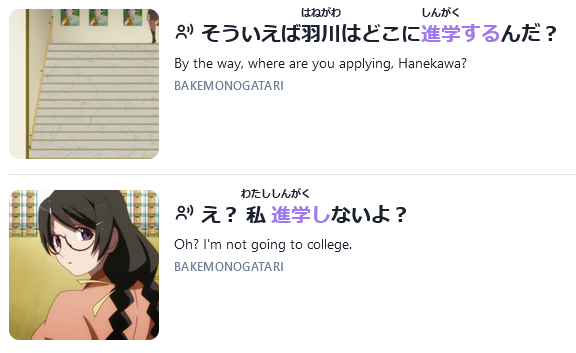
進学する
しんがくする
entering a higher-level school

進=advance, proceed, progress, promote
学=study, learning, science

From what can be gleaned from the kanji, you are advancing or going to another level in your education. In school, it is usually set up where people go to elementary school, then middle school, and then high school.

However there is a choice to get higher education as well. This verb is especially used for going to college. Unfortunately (or perhaps fortunately), Hanekawa Tsubasa doesn’t plan on going.


対話/DIALOGUE

Akatsuki comes back to her apartment to eat sweets with her roommate Yume.
But…

[お菓子禁止]

A:ユメちゃん、クッキーを買ってきた。

B:え?アカツキちゃん、どこで買ったの?

A:新しい店。これはドイツから来たよ。

B:え?ほんとうだ。これって、ドイツ語。

A:食べる?

B:わーおいしそう。あ、でも。。。

A:どうしたの?

B:今ダイエット中だから、お菓子はちょっと。。。

A:あ、そうか。じゃあ、また今度あたしたちは食べよう。

B:1個。。。

A:は?ごめん、聞こえなかった。何か話した?

B:1個だけ。

A:いいよ。お茶を入れる。

B:いや、あたしがする。

あと10分

A:お茶でキー アカツキ、何してるの。

B:あ、ごめん。おいしすぎて止まらなかった。

A:全部食べたの?!も〜 アカツキったら。

[No Sweets]

A:Yume, I bought cookies.

B:Eh? Akatsuki, where did you buy these?

A:From that new store. They came from Germany.

B:Really? You’re right. The packaging is written in German.

A:Want one?

B:Wow, they look good. Ah, but…

A:What’s the matter?

B:I’m on a diet right now so…

A:Oh, gotcha. Then, let’s eat them together some other time, okay?

B:Just one…

A:Huh? Sorry, I didn’t hear that. What’d you say?

B:Just one.

A:Sure. I’ll go make us some tea.

B:No, it’s fine. I’ll do it.

10 minutes later

A:The tea re- Akatsuki what are you doing?

B:Sorry about that. They were so good I couldn’t stop.

A:You ate all of them?! Geez Akatsuki.


タイトルを見る/WHAT’S IN A TITLE

ロンドン橋の死等

ロンドン

This is a katakana for the word London.

As a fun trivia I think this is a good idea to introduce 当て字 or Ateji. See, 当て字 are used to read words phonetically and not for their meaning. Like Paris has 巴里 (パリ)and London has 倫敦(ロンドン).

If you want to know more about Ateji and how it is used in other contexts, I recommend this blog post by Self Taught Japanese here.

橋(はし)の

Just means bridge. Put this together with London and you get well…

London Bridge

The の particle here can be used as a possessive or make verbs and adjectives into nouns. Considering we are already dealing with a noun the former is meaning of の would be good. However, let’s check out the next word to make sure what we are dealing with.

死闘(しとう)

The first kanji is probably familiar. It is the kanji from the verb 死ぬ. This kanji usually means death. The other kanji 闘 can mean fight or war. So it some kind of battle to the death at London Bridge? Surely this isn’t a war going on at London Bridge. But it would make since that there is something going on at a smaller scale.

In other words, a war is made up of many battles. So I’ll go with battle for this. But what about that の particle?

Usually from what I saw in history books, they usually title these battles with the name it took place. For example, Battle of Britain during WWII.

So I would translate this as:

Battle of London Bridge

Simple. However, it does make sense to emphasize the significance of this battle in history with “The”.

This title comes from Vinland Saga. Finished watching a bunch of anime last month on Amazon Prime (gave me a free 30 day trial, and I used it quite a lot XD) and this is one of the shows I’ve been wanting to watch.

I’ll talk about it here without giving too much about the plot. it starts out as a simple tale of revenge but it goes deeper into political gain during the war in the 10th century. It also explores ideas of religion, war, and love.

If you want to watch it, you can find it on Amazon Prime.

BONUS

Considering this was a somewhat easy translation I’d like to take a dive into this bonus feature. Clearly it is a time and a place but I’ve never seen these two kanji put together before so I wanted to try breaking it down here.

西暦1013年10月
イングランド ロンドン

西暦(せいれき)

The first kanji 西 which mean west. Now this is a bit of an aside but, the second kanji 暦 reminds me of the protagonist’s name from Bakemonogatari 阿良々木暦, or Araragi Koyomi. And I know that part of his first name mean “calendar”.

So you could think of this as literally saying “western calendar”. Considering this story takes place in Europe, I can see why they use this. Have you ever heard of AD or BC by years? This is notation from the western calendar and is connected to Christianity. BC stands for the “Before Christ” aka before Christ (Jesus) was born. The AD doesn’t mean “After Death” though (I honestly thought this before doing some research myself). Turns out it stands for, anno domini, which means “in the year of our lord”.

Anyways… this can just be translated as A.D. Simple right? The rest is way less complex.

1013年(ねん)

This is the year 1013.

10月(がつ)

This is the 10th month of the year. Or also known as August. While we’re on dates here, I do like how Japan and England has the year before the month. I bet it really comes in handy with filing things away.

However, I’m not sure why the location is reversed.

イングランド ロンドン

We’ve covered the second word but the first word is just the katakana version of the word England.

There is an obsolete kanji for England as well and that is 英蘭(えいらん)

So you end up with:

1013 AD October
London, England

Here’s a PV:


救世の大冒険/KYUUSEI’S ADVENTURE

第4

博士から電話があった。すごくビリビリそうだった。状況は分からないが、早く帰ってほしいって。もしかしたらまた何かが爆発してた?それなら、ハナビは役に立たないと思うわ。ワカバタウンに早く帰るため、段差に飛び込んだ。

ヨシノシティに出かけた時、あの赤髪のやつが僕を止めた。ほお、ちょうどよかったな。。。あの時、仕返ししたかった。ぶん投げたとき、あいつはモンスターボールを出した。え?!ポケモンがいる?!いつの間に?それとも、いつもいたのか?

あいつにはワニノコというポケモンがいる。

このポケモンは厄介な嚙みつくだなあ。ちょっと待って、どこかでこんなポケモンを見たっけ?まあいいや、ハナビはえんまくの攻撃でワニノコの口の中を狙った。後で、ワニノコの攻撃はだいたい外れた。すなわち、僕たちの勝利だった。あいつの名前を教えてもらった。啓二、か?は!あいつ。。。最高のトレーナーになるって。ワタルとかレッドとか倒すことできると思うのか?僕でさえ倒すことできへん。それを言ったとき、あいつはめちゃイライラした表情を見せて、逃げだした。ケツをぶっ飛ばしなかったけど、楽しかった。もっといい人と初めてポケモン勝負があったら、よかったなあ。お、あかん!帰らなきゃ!

#4

Got a call from Prof. Elm. He sounded flustered. Don’t know what’s going on but he wants me to head back ASAP. Did something blow up again because I don’t think Hanabi will be able to help with that. I jumped over ledges to get back to New Bark Town faster. 

When I was about to leave Cherrygrove City, I was stopped by that red headed guy. Oh good timing… I wanted to pay you back for pushing me. When I pushed him. He threw out a Pokeball. Eh? He’s gotta Pokemon?! Did he always have it?

His Pokemon is called Totodile.

This thing looks like it would have one heck of a bite. Had Hanabi aim a few Smokescreen attacks at its mouth. It could barely make any of its attacks. So your name’s Keiji, huh? Hah! You become the world’s greatest Pokemon trainer. Do you think you can beat Lance or Red? You couldn’t even beat me. When I told him that he got mad and ran off. I didn’t get to kick his ass but man that was fun. Wish my first Pokemon battle was against someone a bit nicer though. Oh crap, right. Gotta get back to Prof. Elm’s lab.

In conclusion, I hope that this series is helpful with your journey to learning Japanese and/or taking an interest in the country’s culture. Until then… また来週!

Kiwi Browser: Good for Web Novels! + New Touch Free Tech & Tsurekano

日本語の練習 第129週

Japanese Practice Week 129

2022年05月15日「日」第129週 

Hello everyone! Starting off with a mobile web browser that allows you to use extensions and what I use to read web novels. We’ll also be taking a look at an article that has some good application for future technology. And lastly we’ll wrapping it up with another page in Kyuusei’s journey in Johto. With that being said, let’s continue.

日本語のイベント/EVENT IN JAPANESE

最近、タブレットでウェブノベルとウェブ漫画を読みました。コンピューターに比べて、タブレットはとても便利です。いつもどこでも使えます。でも、ウェブノベルはちょっと難しいですね。知らない単語、四字熟語など少しわかりにくいので、辞書で引いても仕方ない。

だから、「もっと易しい方法があるはずだ」と思いました。それで、Kiwi Browserというモバイルブラウザーを発見しました。すごく便利なアプリ。このアプリはブラウザ拡張を使わせることができます。使っているブラウザ拡張はFurigana Extensionと10 Ten Reader です。Furigana Extensionは漢字の上にフリガナを付けます。読みながら、知らない単語が出てくると、10 Ten Readerを使ったら、その単語の意味は理解できます。それに、二つのブラウザ拡張はオフラインで動くことができます。

Furigana Extension
10 Ten Reader


AndroidのPlay Storeでダウンロードことができます。(残念ながら、Apple Storeでダウンロードことできそうないみたい。)


N3 文法

[おそらく]

perhaps, likely, probably

I hear this grammar quite a bit in Detective Conan. While watching the show, I imagined them saying “most likely”, モストライク whenever I heard it. It is used to suggest that something is likely the case. It can also be used to make a prediction of a bad outcome.

おそらく + phrase

Ex: これはおそらく間違いない。犯人はあなただ!

  (It is not likely that I’m wrong. You are the culprit!)

Ex: 彼女はおそらくあの人をかばっている。

  (She’s most likely covering for him.) 

[っぱなし]

leaving something on, leaving something still in use

It expresses something staying the same after something has been done.

It can be used in a negative context. Like something bad keeps happening or expressing that you cannot do something.

You can find it paired with にする quite a bit.

V[drop ます]っぱなし

Ex: しまった。誰かがストーブをつけっぱなしにしておいたに違いない。

  (Oh, crap. Someone must have left the stove on.)

Ex: ドアを開けっぱなしにしちゃって。

  (I left the door open.) 

Ex: 遊戯王カードをジーンズのポケットの中に入れっぱなしだったから、洗濯機の中でカードがボロボロにしされちゃった。

  (I left my Yu-Gi-Oh cards in my jean’s pocket, so they got ripped to shreds in the washer machine.) 


N3 動詞/N3 VERBS

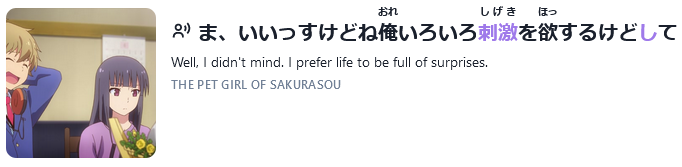
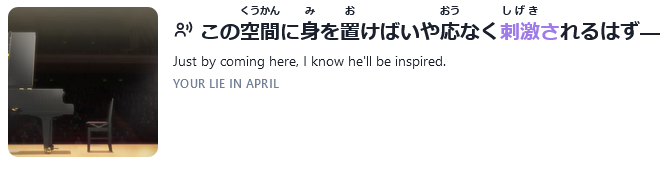
刺激
しげき

刺=thorn, pierce, stab, prick, sting, calling card
激=violent, get excited, enraged, chafe, incite

I like to think of this verb as a thorn pricking your finger. That pain is being sent to your brain as an impulse. This verb can mean several things. It can mean to provoke someone.

It can mean to stimulate like the question Gon is about to be asked.

It can also be used to motivate someone to do something. Like Kou getting inspired to come back to play the piano in Your Lie in April. And it can also mean to excite or thrill. Kind of like how the character here likes his life to be full of surprises.  


記事を読もう/LET’S READ

画面がめんさわらなくても操作そうさできるあたらしいセンサー

New Sensor Where you can Operate Screen Without Touching it.

A company by the name Japan Display, made a new sensor for a touch screen that can be used without touching it.

This sensor is a transparent plate that goes over the screen that is being used. When your finger moves close to the screen, the sensor will pick up the weak electricity between the finger and the screen allowing use touch free.

Japan Display are considering applying these sensors in places such as government offices and restaurants. Starting in April a library in Tottori Prefecture has been using this sensor.

An employee from the company stated “Due to the Corona Virus issue, there are more and more people that don’t want to touch screens. Therefore, we designed a senor that can be placed on these devices we use. We would like others to have a easier time using these devices going forward.”


This is interesting news. If they can do this on touch panels, I wonder if there is a way to put this on other touch screens. Like phones and tablets.

Perhaps we’re closer to tech that let’s interact with it like in the marvel movies.


対話/DIALOGUE

Learning a new language can open you up to new forms of entertainment.

[日本語を勉強してる理由]

A:ね、それは「かぐや様」の新書なの?

B:うん、これはBOOK WALKERで発表したばかりだ。読む?

A:いや、こんなレベルではちょっと早い。だから、英語版だけ読む。

B:あ、そうか。フリガナがないので、やっぱりちょっと難しい。ときどき、知らない単語を見たら、辞書を引く。

A:読んでみたいなあ。こんなものは英語版がいつも遅かった。

B:うん。主に日本語を勉強している理由なんだ。

A:え?ほんとう?全然考えなかった。やってみるかもね。

B:最近、何を読んでるのか。

A:「よつばと」。

B:あ、初めての漫画なら、いいと思う。小説を読んでみた?

A:ううん、べつに。

B:角川つばさ文庫のレベルはおすすめよ。怪盗レッドはいいシリーズ。ほら、見てみろ。

A:よかったら、貸してあげる。

B:いいの?

A:いいよ。

B:ありがとう。

[Reason to Learn Japanese]

A:Hey, is that the new volume of Kaguya Sama?!

B:Yeah, it just came out on BOOK WALKER. You want to read it?

A:Nah, I’m not good at reading at that level yet. So I’ve only been reading the English version.

B:Ah, I see. It is kind of difficult considering there’s no furigana. I have to look up some words in a dictionary sometimes.

A:I wish I could read it. The English publication is always behind when it comes to stuff like this.

B:Yeah. That’s one of the main reasons why I started learning Japanese.

A:Eh? Really. I never thought about that before. Guess I’ll go read now.

B:What are you reading?

A:Yotsuba.

B:Ah. That’s good manga to start out with. Have you tried novels? 

A:No, not really. 

B:I recommend the Kadokawa Bunko books. Kaito Red is a pretty good series. Here, take a look.

A:Hmmm…. Oh, cool. There’s a few words I don’t know, but I can read the majority of this.

B:I’ll let you borrow it, if you want.

A:Are you sure?

B:Yeah.

A: Thanks.


タイトルを見る/WHAT’S IN A TITLE

継母の連れ子が元カノだった

継 母(ままはは)の
The first kanji can mean inherit or continue. The second kanji means mother. You can think of this as someone inheriting the title of a mother. And who is able to do that. Someone who adopts a child? Someone who remarries to a person who has children? The latter here is the correct choice. This word means “stepmother”.

Now the の particle is most likely a possessive particles here, so we will change this to “stepmother’s” for right now.

連れ子(つれご)が
This word is related to our previous word stepmother. The word 連れ comes from the verb 連れる which means to follow. The kanji 子 can mean child. So this literally means a child that follows. In other words, a child from a previous that follows the parent into another marriage. AKA a step child.

Considering we are already referring to the mother in question as a stepmother it would be best to translate this as just child. Considering there are two characters on the front cover we don’t know which one is her child. She could have either a son or a daughter. So let’s just keep it as “stepmother’s child” for now and go on to the next word to find that answer.

The が puts emphasis on this person who is the stepmother’s child. We’ll put this as “is” for now.

“My Stepmother’s Child is”

元(もと)カノ
元 can mean origin and many other things. It can also be used as the prefix ex- or the word former. The word beside it カノ is short for 彼女 (かのじょ)which can mean girl or girlfriend. In this context, we are dealing with an ex-girlfriend.

Now that we know that the stepmother’s child is a girl, we can put daughter instead of child.

“My Stepmother’s Daughter is my ex-girlfriend”

だった

This last part is the casual form of the copula でした. This is the past tense of だ/です as well. So you could turn the is into was in this translation and get “My Stepmother’s Daughter was my ex-girlfriend” but I’ll be sticking with my previous translation. It kinda sounds weird if I keep “was” here.

I’m guessing that they used the past tense here as some kind of shock to the character experiencing this. Like the news of their parents getting married just suddenly fell into their lap and he’s just finding out his ex is now his stepsister. With a title like this it really reminds me of Domestic Kanojo. So final translation:

“My Stepmother’s Daughter is my ex-girlfriend”

This title is from a web novel I am currently reading. Just finished the fourth chapter on Friday and these two are quite the pair. Our main protagonist, Mizuto Irido, was jealous because his girlfriend was becoming more social (therefore more popular) and the heroine, Yume Ayai, had a misunderstanding about him cheating. So, in their last year in middle school, they break up.

As a bit of relief, they thought to themselves: Thank God I never have to see him/her again. But… right before they start their new lives as high school students, they end up becoming step siblings. They kept their relationship hidden from their parents and now they have to live in the same house. Unfortunately, it doesn’t end there. They’re going to the same school, too.

So far, it’s an interesting read. Plus they both like the mystery genre so they throw in a few head nods to a typical fan of mystery. This novel is also done by the same writer, Kamishiro Kyousuke, who made 僕は君の謎解き (I’ll Solve Your Mystery), which I talked about here.

The web novel ended up rising in popularity and it ended up getting a light novel serialized and a manga as well. On top of that an anime for this very series will be coming out this summer. So, I’m definitely looking forward to seeing how it will animated.

If waiting isn’t your thing, and you can read Japanese (hopefully, Kiwi Browser can you help you out), you can start reading the web novel here. And if you are more into manga, you can find a few chapters here. And if you interested in more of the story you can buy the light novels or the manga on BOOK★WALKER.

Here’s a PV of the anime:


救世の大冒険/KYUUSEI’S ADVENTURE

第3

家を見たとき、草からトランセルが飛び出した。攻撃しなかったけど、うざかったわ。こいつのシェルはだんだん固くなって、倒しにくい。ハナビは火の技を覚えることができるかなあ。家のそばで合図を見た。間違いない。ポケモンおじさんの家。

そ、彼はポケモンおじさんかあ。ポケモン育って屋から来た卵をもらった。ちょっと待って、あの人は大有名カントー地方のオーキド博士か?!ポケモン図鑑をもらった。レッドの事を尋ねたけど、博士が行っちゃった。ラジオショーに行かないとって。追うつもりだったけど、ハナビは疲れそうだったから、ポケモンおじいさんの家で休んだ。いつか博士にまた会えるかもしれない。

ハナビは休みながら、家の周りを見た。ポケモンおじいさんは世界中にコインと本を集めるはずだろう。どこから来たのかさっぱりわからん。何語だ?それにでかいコンピューターなんて、なぜここに?あ。。。壊れました。さ、ハナビはよく休んだ。行こう。

#3

Right when I saw a house, a Metapod appeared. It didn’t attack but it was annoying. It kept hardening its body and made it harder to beat it. Wonder if Hanabi will be able to learn a move where she can use her fire. I take a look at the sign by the house. No doubt about it. It’s Mr. Pokemon’s House.

So this is Mr. Pokemon. He gave me an egg he got from a Pokemon Daycare. Wait a minute, is that the Professor Oak from Kanto?! He gave me a PokeDex. I was going to ask him about Red but he left. He said he had a radio show to get to. I was going to chase after him but Hanabi looked tired, so I rested a bit at Mr. Pokemon’s house. Maybe I’ll see him again someday. 

While Hanabi was resting, I took a look around the house. Mr. Pokemon must collect a lot of coins and books from all over the world. I barely know where any of them are from. What language is this? And what are these giant computers doing here? Oh… they’re broken. Now that Hanabi has gotten some rest, it’s time to go.

In conclusion, I hope that this series is helpful with your journey to learning Japanese and/or taking an interest in the country’s culture. Until then… また来週!
Learning Resource: JRPGs + What does 推し mean

日本語の練習 第128週

Japanese Practice Week 128

2022年05月08日「日」第128週 

Hello everyone! We’ll be starting with a introduction to a Youtuber I’ve been watching recently, going over some grammar and a verb. Up next will be a little review of the web manga I’m reading on Comic Walker. Plus, Kyuusei’s journey is off to a good start just have to find Mr. Pokemon. With that being said, let’s continue.

日本語のイベント/EVENT IN JAPANESE

最近、実況で日本語を試してみましたが、ゲームで日本語を教える動画は少し珍しいですね。ゲーム言語のことを話したけど、新しいユーチューバーのTeedyanさんはゲームで日本語を教えてくれた。

ファイナルファンタジーとかクロノトリガーが好きなら、この動画はおすすめです。


N3 文法

[をはじめ]

for example, starting with

N+をはじめ
をはじめとして
をはじめとする

Used to give a main example and give examples of that main one. Like not only is the dollar a currency, the yen and the pound are too.

The difference between the first grammar usage (N+をはじめ) from the others is that it modifies nouns. The other two are used to just connect two sentences.

Ex:彼女をはじめ、家族全員もう知ってる。
Not only does she already know, the whole family does.

Ex: このゲームには、日本語をはじめとするふりがながあるから、初心者向けです。This game has Japanese language support and furigana so it is good for beginners.

Ex:カズコ先生をはじめクラスメートたちのおかげで、日本語がもっと上手になりました。
Thanks to Professor Kazuko and my classmates, I’ve become better at Japanese.

[おかげで]

thanks to, because of

There are a few ways this grammar can be used

V[Plain Form]おかげで
いーAdj+おかげで
なーAdj+な+おかげで
N+の+おかげで

*More polite version would be おかげさまで.

As shown in the last example sentence, this is used to say that you are grateful towards something or someone. Like if someone does something for you and it benefits you. 

On another note, it can be used sarcastically when something someone has hindered you.

Ex:静かに勉強させてくれるおかげで、仲良くすることができました。
Because you let me study quietly, I was able to pass.

Ex:はや朝にルームメイトがうるさいおかげで、眠らなくて、とても眠くなった。Thanks to my roommate being loud early in the morning, I couldn’t sleep, and I’ve become sleepy.

Ex: 図書館が静かなおかげで、もっと勉強することができました。
Because it was quiet in the library, I was able to study more.

Ex: 癖のおかげで、探偵の正体がぎりぎりバレた。
Thanks to his habit, the detective’s true identity almost got revealed.


N3 動詞/N3 VERBS

成長する
せいちょうする
To Grow

成=turn into, become, get, grow, elapse, reach
長=long, leader, superior, senior

By looking at the kanji and their meaning, we can sort out how this verb works. The first kanji seems describe change or growth while the other kanji describes becoming greater or taller (long).

This verb can take on the a few meanings. It can be used to describe a business or the economy growing. But I know it more for when someone is saying someone has grown up. Like Menma and her friends in Anohana.


対話/DIALOGUE

Yumi is going to the mall when she notices that Jeremie is playing a certain game.

[ペルソナ5スピードラン]

A:ね、ジェレミー、モールに行く。なにか要るの?

B:あ、ユミと一緒に行くよ。ちょっとまって、これセーブする。

A:あれ、それはペルソナ5じゃないの?ちょっ。。。10月2日って。。。29時間もやったのに、奥村のパラスはもう終わった?

B:うん。日付でわかるなんて、少しびっくりした。

A:さ、3回やってた。とにかく、スピードランしてる?

B:まあなあ。100パーセントランをやってみるけど。

A:テキストがいっぱいなんて、意外だなあ。はじめての実況プレイは90時間ぐらいだった。

B:よし、行こう。ちなみに、何を買うのか?

A:新しいヘッドホン。僕のが壊れたから、買わないと。

B:ついに壊れたなあ。そのヘッドホンはずっと前からね。

A:うん、隣の店は売っていてよかった。

B:別の色を選ぶのか?

A:いや、黒いのが一番いいよ。

B:好きな色は青じゃない?

A:そうですけど、黒は特急の感じだよね。

B:一応 ※サッパリわからない

[Speed Running Persona 5]

A:Hey, I’m heading to the mall. Do you need anything?

B:Oh, I’ll go with you. Hold on, I gotta save this first.

A:Is that Persona 5? Wait… October 2nd… you’ve only played the game for 29 hours and you’re already done with Okumara’s Palace?

B:Yeah. I’m kinda surprised you can tell just by the date.

A:Well, I played it three times. Anyway, are you speed running?

B:Sort of. I’m trying to go for a 100% run though.

A:I’m kind of surprised that there’s so much text. It took me about 90 hours to finish my first playthrough.

B:Alright it’s saved, let’s go. What are you going to buy anyway?

A:A new pair of headphones. Mine broke, so I really need to buy another pair.

B:Darn they finally died huh? You’ve been having those for years.

A:Yeah, but luckily they still sell them.

B:Thinking about getting them in another color?

A:Nah, the black ones are the best.

B:Isn’t your favorite color blue, though?

A:Yep, but black has a classy feel to them, you know?

B:I guess. *Doesn’t have a clue*


タイトルを見る/WHAT’S IN A TITLE

妹が推しすぎる!

妹(いもうと)が
The first word is usually known as “little sister” or “younger sister”. The が here is just to emphasize something that this little sister is or does. But that depends if the next word is an adjective/noun or a verb.

推(お)しすぎる
The kanji 推 by itself can mean push, as in 押す(to push). It could mean to push for something or someone. Or rather to endorse them. However the noun version for this word fits better. It has an informal context as well. It is for someone who is a fan and is “pushing” that thing their into as support.

Another note about 推し is that it can also be used to talk about your favorite idol, anime character and the like. Learned that from another manga I’m reading. Talked a bit about that manga here.

Now the すぎる part. This give words a sense of being excessive. Like I drank too much (飲みすぎた). Or talking about something being way too expensive (高すぎる).

Since this is the noun, I’d probably go with “Huge Fan” to express that she can be a little overboard with her fandom. But what is she a fan of? That comes apparent in the first chapter, but I’ll get into that later.

Overall, I would translate this to

“My Little Sister is a Huge Fan”.

Bonus: Chapter 1’s title

100万人に推される妹

100万(まん)
The kanji 万 means 10,000. But there’s a 100 in front of that kanji. In the past I used to have trouble with counting these kinds of things. So in the beginning, I thought of it as a math problem. It is just 100 bundles of 10,000 yen. so 100 times 10,000 = 1 million.

Or you can think of it as adding 4 more zeroes when you see this kanji and a number.

100万 = 1,000,000

人(にん)
This can also mean “person” or 人(ひと), but this is a counter for people. So together with the number we saw previously, we have “1 Million People”.

に推(お)される妹(いもうと)
Now this is the passive verb form of 推す, which means to endorse, to support, things like that. The passive verb form is used to say to make someone do something.

And of course 妹 = little sister. However, she’s not any typical little sister I mind you. The rest of the title is being used to describe her. When you start putting a verb with a noun, you open a new pathways to express things in Japanese. Like George from Japanese from Zero Lesson, where he talked about a man who is wearing a pink suit or ピンク色のスーツを着ている男.

So, in all it would be:

My Little Sister Whose Backed by 1 Million People

This title comes from a manga that I started reading a couple of days ago on Comic Walker. Follows a story of a manga artist who lives with his sister. He is very inept when it comes to technology and his manga isn’t doing so hot. Pretty much on the brink of getting the axe (aka cancelled). On the other hand, his little sister is quite tech savvy and has a great following on her videos. They both tried to hide this part of them form each other but one day that all changes. If you are interested you can find the first two chapters (as of now that’s all they have) on Comic Walker here.


救世の大冒険/KYUUSEI’S ADVENTURE

#2

ヨッシャ。はじめてのポケモン勝負。オタチだ。ハナビであのふわふわのやつを倒したが、疲れそうみたいだ。博士の研究所に行く前に、ポッポが出てきた。怪我したら、ハナビは持ってる実を勝手に食って、回復した。お、役に立ったかもな。すごい。ハナビは新しい技を覚えた。えんまくという技。これで、忍者のように動くことができるさ。この技でコラッタにつかったけど、あいつの攻撃がまだ当たった。もっと使えば使うほど、相手の攻撃をミスするかも。変な木を見つけた。ほら!これは実じゃないか。ハナビにあげた。

ヨシノシティに到着した。おっさんは街を案内するみたいだったけど、僕はいい。ポケモンセンターという所に行った。ここでポケモンを回復することができそうだ。しかも、無料だし、看護師は優しい。いろいろなものを買うことができる店に行ったとき、男の子は僕に毒で彼のポケモンが死んだと伝えた。虫タイプポケモンのどくだと。ふむ。。。万が一毒消しを買ったほうがいいかもな。

ポケモンおじいさんの居場所のことを尋ねた。この街の先にあると言った。他の木の実を見つけた。それでおっさんは実をもらった。本当に助かったぞ。また博士に会う前に、ハナビはもっと強くなってほしい。道路の途中でこいつらはポケモンバトル中だから、この道を邪魔だ。面倒くさい。お、別の道がある。よーし、出発するぞ。

Alright. My first Pokemon battle. It’s a Sentret. Hanabi took it down but now she looks tired. Before I could make it back to Elm’s lab, a Pidgey appeared. When Hanabi took damage she ate a berry that she was holding and got better. Oh, that’ll probably come in handy. Cool Hanabi learned a new move called Smokescreen. Now we can move around like ninjas. Used on a Rattata but it still was able to strike. Maybe if I use it more it’s attacks will miss. Found this weird looking plant. Hey! It’s a berry. Gave it to Hanabi.

Made it to Cherrygrove City. Some old guy wanted to show me around but I’m good. Went to a place called the Pokemon Center. Looks like I can heal my Pokemon here and it’s free. Plus, the nurse is nice. Went to a store where a guy told me about his Pokemon dying from being poisoned by a bug-Pokemon. Hmm… might want to buy some antidotes just in case.

Asked a guy if he knew Mr. Pokemon’s whereabouts. He told me he’s passed this city. Found another berry tree and an old guy gave me one. These will definitely come in handy. I plan on making Hanabi a bit stronger before we see the professor again. These guys are having a Pokemon battle in the middle of the street so I can’t get by. What a pain. Oh, looks like there’s another path. Alright let’s go.

In conclusion, I hope that this series is helpful with your journey to learning Japanese and/or taking an interest in the country’s culture. Until then… また来週!

Design a site like this with WordPress.com
Get started