二人(ふたり) You may know this as the word for people. However, when put together with a number it is the counter for people. If you are familiar with Naruto, think of the group Legendary Sannin 三人, which consist of three people: Jiraiya, Tsunade and Orochimaru.
So this is “Two people”.
の This is just a possession particle tying 二人 with the next word 探偵. It can mean “of” or an apostrophe s (‘s) depending on the situation. In this situation, it will be written as the former rather than the latter. (Bonus it can also be given to someone with a title or certain feature or characteristic is put with their name. For example, 麦藁のルフィ= Mugiwara no Luffy = Straw-hat Luffy)
探偵(たんてい) This is probably one of my most favorite words (mostly because of 名探偵コナン). It is the combination of the Kanji 探, which you may notice from the verb 探す, which means “to search for” or “to look for”, and 貞means “spy”. So, put together you can make a good guess at what this word means. A spy that is looking for something. Hmmm… A detective.
With that expalined I think it is best to change some words to make the title’s translation flow better. Instead two people, I’ll change it to “Two Detectives”.
第(だい)二(に)幕(まく) The first kanji 第 is usually set as prefix for ordinal numbers. Think 第一(first) or 第二(second) or 第三(third). So, this means the second put together, but what about 幕?This kanji reads as a curtain on (more so on the side of a curtain on a stage) or an act in a play.
Considering our last words “The Second Curtain” would not sound correct so “The Second Act” would be best.
So, put together you have “The Two Detectives Second Act”.
And Funimation decided to go with the same translation this time around. This is only because this title would only make sense in this way… I think. Plus, I don’t think there is no room for interpretation on such a title.
This title has come from the last episode of 憂国のモリアーティ or Moriarty the Patriot. I was somewhat sad to see this anime go one episode early when it aired back in Fall 2020. Luckily, it has second season.
Sherlock Holmes is always getting the spotlight in many books and shows. Alas, Moriarty does not get that much attention. Here comes Moriarty the Patriot to make us understand how brilliant this character can really be. Sure, you see his exploits in different media, but I’ve never seen Moriarty be the main protagonist of a show.
Detective Boys by Edogawa Ranpo had many enjoyable moments from start to finish. It was a battle of wits between Twenty Faces and Akechi Kogoro. I do wish that the Detective Boys were able to do more as a team like in the beginning of the book.
It was great to see where Detective Conan’s Detective Boys got there namesake and badges from. The gadgets that they had were interesting as well. Like the fountain pen flashlight.
LANGUAGE LEARNING
This was my first time reading an old book so it was difficult to follow in some parts. Luckily this Aoitori version that I bought on Bookwalker has furigana. I didn’t look up that many words this time and used context to understand what was going on.
If you’d like to listen to it being read to you, luckily there is a YouTube channel that has read this book. I left comments on the videos for this story with timestamps on when each chapter starts. This version of the book does have more chapters but majority of the chapter names and content are the same.
I did find some interesting phrases/words such as:
立(たち)ちすくむ:To be petrified
片言(かたこと):broken language, imperfect speech
狐(きつね)につままれる:to be bewitched by a fox, to be confused
鳩(はと)が豆鉄砲(まめでっぽう)を食(く)ったよう:like a pigeon who’s been shot by a peashooter (in other words like a deer in headlights, or wide-eyed in shock)
This word has many similes in English like “seriously”, “properly”, “sufficiently”, etc. I’ll go with “properly” since that is what I mostly see it being read as.
吸えない(すえない)
This verb is the negative potential form (what I used to call the え(E)-form). When this form is put on a verb it means that the verb can’t be done.
The base of the verb is 吸う, which means “to suck”. However with the E-form, 吸えない, it is turned into “can’t suck”. Put this with ちゃんと and you get something like “properly can’t suck” or “can’t suck properly”.
吸血鬼(きゅうけつき)
Oh there goes that kanji again from 吸う。This time the kanji for blood 血 and monster or demon, 鬼, are put together. So, together it literally means suck blood demon. Let’s rearrange that so it makes more sense in English: Demon that sucks blood. Hmm… sounds like a vampire doesn’t it?
If you were thinking that then you are correct (then again the picture kinda gives it away).
When you start putting a verb with a noun, you open a new pathway(s) to express things in Japanese. Like in this video that George from Japanese from Zero made:
So far we can translate this to: “The Vampire that Can’t Suck Properly”. But wait, we still have one more thing to cover.
ちゃん
This is a suffix that is put after someone’s name (or in this case what someone is). Usually given to women and girls but can be used for guys as well. You only use this when you are quite familiar with the person though. Like a friend, or relative or that old lady who bakes cookies for you every now and then. Basically it’s a term of endearment and affection.
So, this will end up as (in a somewhat literal translation) “The Vampire-chan that Can’t Suck Properly”. But that English seems a bit weird. So the final translation will be:
“Vampire-chan Can’t Suck Properly”
And here is a past discussion:
Right on the money. But then again if it ever gets an official English translation they will probably change it to something else. This title comes from a manga I started reading last week. The title basically tells you the plot itself. This vampire basically can’t suck blood. It follows the story of this vampire girl, named 石川(いしかわ)月莱(read as ルナ, not an actual reading of this kanji)who transfers into a high school.
It’s not really explained why this school has a vampire attending and everyone knows she is a vampire. I’m guess it’s something like 亜人 デミちゃんは語りたい or better known as Demi-chan Kataritai, where everyone knows that people like dullahans, succubi, snow women, and vampires are real and they try to coexist.
However, Runa (or Luna), regardless of her being a vampire, can’t suck blood. So another one of our main characters, 大鳥(おおとり)辰太(たつた). Based on his name I’m really hoping he’s not some phoenix or dragon or a hybrid of the two. Anyways, he basically becomes something like a mother to her and lets her suck his blood so she can get better at it.
If you are interested you can find the manga on Comic Walker at the link below. I’m caught up to the 6th chapter (7th released a while ago) but there are some chapters that are gone now. You can still read the first 3 though. I hope that they get this on Book★Walker (they have 3 volumes out now).
I’ve finished two books and reviewed them on there entertainment and learning. In July, I read Digimon: Last Kizuna Evolution. I used to hate it when I couldn’t go watch anime movies in theaters due to it being a one or two day thing. Luckily, with these novelizations, I get to enjoy the story.
I still have about 6 chapters of 少年探偵団 to read but I should be able to finish it before the month is over. Just like the Detective Conan novel, even though it has furigana it’s hard to read. The vocabulary is relatively old (they had to explain some terms here and there in the Aotori Bunko version and relate how much money some things would cost in our time). I’ll get into more detail about this book in the review later this month.
Beat Kingdom Hearts in Japanese
I successfully beat Kingdom Hearts on Proud Mode. It was a fantastic experience going through the game on my own. You know, instead of scripting dialogue, translating, making explanations, etc. on substack. Great experience and it gave me an even greater appreciation for people who work in translation and localization teams. I think I’ll write up a separate review for this game.
Right after finishing that, I started playing one of my least favorite games out of the series: Re: Chain of Memories. Forgot it has a lot of text and no cut-scenes when you are going to the different worlds. For the most part, I was able to understand majority of the text so I guess that’s good.
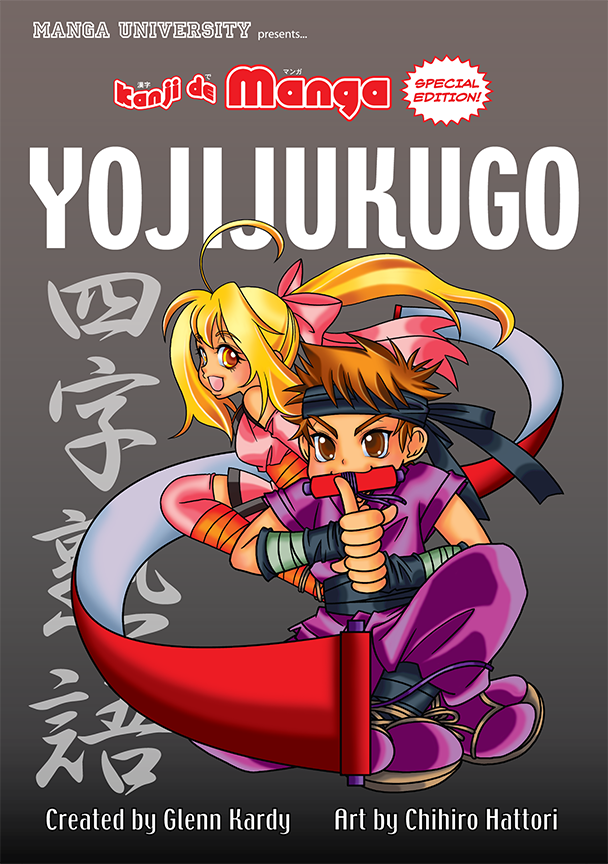
Finish Reading Kanji de Manga: Yojijukugo
This was a fun book to look over and I bookmarked a few of them for future reference. I talked a bit about it on a Japanese Event a while back here if you are interested.
PROGRAMMING
Finish Python Crash Course Book
Decided to focus only on Python. I got through the chapters and the first two projects. The Django project is a whole other beast. I think I might have to do it all over again.
While struggling through the last project, I found a useful YouTube channel called Learning Python. Tried getting it connected to the server… And it didn’t work. I’m so used to Pycharm Community Version taking care of everything so running the command prompt was out of my reach.
If you are going through this book I do recommend his playlist. Just be careful with the command prompt stuff when you get to the Django project. He uses a Mac and the commands are somewhat different from Windows.
I did make a small program that makes a monthly reading plan. I have it set up where it asks the user how many pages are in the book, how many pages they want to read each day, etc. It tells the user whether that is possible or not. If it is then it puts out a monthly reading plan. There are many things I still want to do with it but here’s a screenshot of the results when I used it for the Detective Conan book.
Since I got a lot of python books from Humble Bundle, I think I’ll give Automate the Boring Stuff a try like Michael suggested. Or the Impractical Projects. Now that I have the basics, I’m looking forward to what else I can make.
Shogi
Solve 5-move Tsume Puzzles
Solved all 63 puzzles in the Tsume Shogi Book. They were harder to figure out but they were fun to do. Even found myself solving more than two a day.
澄(すみ) Considering this is given an honorific (two but we’ll get to that), we can safely assume this a name. However there are many ways you can interpret this as a name. They call this 名乗り(なのり)which means name readings of kanji. However, this kanji has four different names. There is:
※きょ ※すす ※すみ ※み
After reading the chapter, I found out that it was すみ.
ちゃん This is an honorific suffix that is usually given to someone’s name that you are close to. In this chapter, a tall girl named 瀬楽(せらく・Seraku) is talking about her best friend, Sumi-chan. But what’s with the さん? We’ll get to that next.
さん Before I read the chapter, I interpreted it as someone trying to add a familiar tone to a person’s name while still trying to be formal. As I read the manga, one of the main characters of this manga calls her 澄ちゃんさん. I figure this is because she has no deep relationship with this character so she adds the more formal honorific suffix さん onto how she was introduced to the name 澄ちゃん by Seraku。
So far we have “Sumi-chan-san”. But this seems to be too many suffixes to me so I’ll change さん to Ms. instead. So we get “Ms. Sumi-chan”.
と
Depending on the situation, this particle can mean “and” or “with”. So, after looking at the rest of the title I’ll make my final decision.
女子(じょし) This can mean “woman” or “girl”. Considering this manga is in a high school setting, I think that “girl” would be best here. I mean 女子makes up one part of JK aka 女子高生(じょしこうせい)or High School Girl.
の This is a possessive particle so it’ll take on the form of an apostrophe s on our last word 女子. So we have “girl” turn into “girl’s”.
証明(しょうめい) The first kanji (証・しょう)means “proof” or “evidence” or “certificate” and the second kanji(明・めい) means “light” or “bright”.
Put these two kanji together and you are shining a light on the evidence. Letting people know that there is evidence or proof to something being stated. In a short and less poetic explanation it just means “proof” or “evidence”.
After the と, we have “Girl’s Proof” or “Girl’s Evidence”. I’ll go with the former. So let’s see which makes more sense for と. Will it be “Ms. Sumi-chan and the Girl’s Proof” or “Ms. Sumi-chan with the Girl’s Proof”? Once again, I’ll go with the former. And of course there is roman numeral 1 at the end so I’ll add that…
So in all, we have…
“Ms. Sumi-chan and the Girl’s Proof I”.
This chapter title comes from a manga called 僕が答える君の謎解き which means “I’ll Solve Your Mystery”. I finished the manga last month and ended well. You can find me blabbing about all the chapters on MAL.
Here are some past thoughts on this title.
Considering this chapter just came out yesterday there isn’t an official translation just yet.
This manga is being adapted from the novel written by Kamishiro Kyousuke (known mostly for Mamahaha no Tsurego ga Motokano datta). In the manga, the character design is done by Haori Io and the art is done by Higuchi Mei.
This is a mystery manga about a girl named Rinne who is gifted when it comes to solving mysteries. However, she only gives the answer (the culprit) without telling her clients the other details and how she figured it out. Luckily she has a fellow student working with her. A boy named Touya, who tries to reel Rinne in, investigates the case, and helps her explain the details for the client. If you are interested, you can find the first chapter on comic walker.
郷(ごう) This kanji can mean “hometown (きょう)”, “country(ごう)”, or “village(さと)” depending on which reading you use. Since we already know the correct reading for this we can go with “country”.
に A destination marking particle. Since we are talking about a country it is safe to say that it should be translated to “in”. It could be “to”, but I’ll change it if need be later on.
入り(いり) This comes from the verb 入る(いる)which means “to enter”. You can also interpret this as “entering” when you are using just 入り(いり). So we’ll go with “entering” for now.
ては
は is a topic marker particle that usually means “is”, but when put together with て, it takes on the meaning of if.
To go into more detail it is an expression that means “if you are going to…”. So from what we have gathered from the other words it seems someone is entering a country.
So, we can translate this to “If you are going to enter a country then,”.
郷(ごう) Same as the first word, so it means “country”.
に Another destination marking particle. So this could be “to” or “in”. Let’s look at the next word to make the decision.
従え(したがえ) This is a verb that means “to obey”. It’s more suited and used for obeying laws, rules, or an order. It has many other similar meanings as well like “to follow”, “to abide by ” and “to conform to”.
So I’d translate this into “Conform to the country” or “Obey the country’s laws”. Think I’ll go with the former.
“If you are going to enter a country then” + ”Conform to the country” =
If you’re going to enter a country then conform to the country.
This means that if you travel to another country then you should conform to how that country does things. This seems similar to a common phrase:
When in Rome, do as the Romans do.
合わせるって(あわせるって)
I’ve seen this kanji from another verb, 合う, which means “to match” or “to fit”. The って at the end can be used to quote things like 仕方ないって (“It can’t be helped” you say). In some situations って can be used to put what someone says into question. Kind of like you are trying to confirm if that is what they seriously think.
Furthermore, it can also mean “as for the term” or “As for”. I’ll be taking some liberties here and using something similar to “as for”.
“To fit in” ← I think this would be a good translation.
大変(たいへん)
So in this word we have the kanji 大(たい)which means “big” and 変(へん) which usually means “strange” and similar words to it. However, there is a more suitable meaning for this context. That would be an “incident” or “change”. So together this means “big incident” or “big change”.
But that still doesn’t seem to be right. So I think it should be the word “difficult” or “hard”.
です This is a copula. Or in other words a full-stop period that lets us know that the sentence is over. And speaking over let’s get this part over with.
“It’s hard to fit in.”
Similar but considering the show, I think “It’s hard to fit in” would work better here.
This episode title comes from the 4th episode of 小林さんちのメイドドラゴンS or Kobayashi’s Dragon Maid S. The S just stands for Second as in (Second Season). Other than this show I’ve only seen Railgun add S (for second season) and T(for third season) with their sequels.
Anyways, This show follows the slice of life story of an OL (office lady) that takes in dragons from another world. Pretty out there right. But wait there’s more. The dragon, named Tohru, feels indebted to Kobayashi so she ends up becoming Kobayashi’s maid. Her Dragon Maid. After Tohru shows up, more dragons start to flood into Japan and into Kobayashi’s mundane yet peaceful life. Kobayashi’s days become livelier as she teaches Tohru and the others how to live in this new world.
Now after 4 long years, Kyoto Animation (the studio who worked on the first season and currently this season) are back and hitting the ground running (If you haven’t seen the first season, you gotta try it out because the 1st episode of this season is amazing). There was an arson incident that occurred a couple of years ago. At the time, I feared that the studio was going to shut down. I’m really glad that they are back.
The OP from both seasons are very catchy. So I’ll put them here as well.
The group known as fhána made this song. If you are interested, here is their music video.
I love how it looks like the first OP from Nichijou. Another fantastic show made by Kyoto Animation.
fhána also made a music video on the Dragon Maid’s second season OP as well.
※The second OP’s music video has subtitles in English, Japanese and Korean.
This title comes from episode 951. If you are not caught up on One Piece I won’t spoil much for you. (With a title as vague as this, it doesn’t really give much away.)
オロチ This is someone’s name. Names are usually written in katakana in Shonen anime like One Piece. The name is Orochi. If you remember Orochimaru from Naruto (if you watched it that is), then you will probably get the idea that this name has to do with snakes and you would not be mistaken.
Orochi means big snake or serpent. There is also something called a やまたのおろち (Yamata-no-Orochi), which means eight-headed, eight tailed serpent. This is a serpent from Japanese mythology which also appears in Persona games.
の This is a possession particle where someone or something is taking possession over another person or thing. 僕の靴 (My shoes)、私達の勝利 (Our win), ヒビキの日記 (Hibiki’s journal).
追手(おって) This means pursuer, pursuing party, or posse.
So, to put the first sentence together we have オロチの追って!which means “Orochi’s pursuing party”. This means that Orochi has a party, a band of people, that are pursuing someone or something. Now, on to the next part.
忍者・軍団(にんじゃ・ぐんだん)
Kanji can be grouped together like this so to make it easier to follow, I have split the word up into a more comprehensible way with a dot. On the left side we have にんじゃ. Many may be familiar with this word. It says ninja.
On the right side, we have ぐんだん, which means something like an army corps, which is a group that is under someone else’s command.
VS
Now you are probably wondering “Why is he going over this, we already knows it says VS aka versus”. This only because when the title is being said by Luffy, he says たい instead of VS/Versus. But what does たい mean actually. Basically the same thing. Someone is opposing someone else or in this case someone is fighting someone else (hence the VS).
ゾロ
Katakana. Must be another name, and his name is Zoro. So let’s wrap this last part up.
Put this second sentence together and we have 忍者軍団VSゾロ which means “Ninja Army Corps (group) VS Zoro”. This means that Zoro is going to be fighting a band of ninjas. Now the translator’s have translated this title to English making it:
“Orochi’s Hunting Party! The Ninja Group vs. Zoro!”
Have some important things to take care of so I’m going to be taking a break from the weekly posts. Still going to do the book review. I’ll post a previous What’s in a Title on Sundays for now.
When I saw this book on my second trip to Kinokuniya, I hurried up and grabbed it off the shelf. If you haven’t notice by now, I’m a huge fan of Detective Conan. This novel is separated into three cases involving the Black Organization. The following is the list of the cases with their respective episode and volume they are from:
Reunion with the Black Organization (Ep. 176 – 178, Vol. 24 Files 7-11 )
On the Trail of a Silent Witness (Ep. 309 – 311, Vol. 37 File 5 – Vol. 37 File 7)
Contact with the Black Organization (Ep. 309 – 311, Vol. 37 File 8 – Vol. 38 File 1)
It was fun to read the majority of the book while being able to remember majority of the plot from when I watched it about 7 years ago. The third section wasn’t as enjoyable as the first and second due to it following up on the peak that occurred in the second section of the book.
Overall, I’m happy to make this my first ever physical novel.
LANGUAGE LEARNING
This will be the first and (hopefully) last time I underestimate a book just because it has furigana. This book has furigana but, the vocabulary was kind of hard. Especially around the deduction parts. You can probably piece the deduction together with context clues but have a dictionary just in case.
Majority of the grammar was relatively easy to understand. Found some interesting technology words and even a voicemail template that I can use.
Since I enjoyed this mystery novel, my next book will be 少年探偵団 (Detective Boys) by 江戸川乱歩 (Edogawa Ranpo).
It’s a lot shorter than the book I read for this month but it appears to be interesting. Plus, it looks a bit spoopy so its the perfect thing to end the summer off with.
Very self explanatory here. Having a bad mouth in the US usually means using vulgar language. However, in Japanese it is more than that. You can use it to express someone saying horrible things about you at your past job like in RELIFE. Or someone talking bad about you behind your backs like in One Week Friends.
対話/DIALOGUE
Can’t believe they haven’t watched it yet.
[見なかっただと?!]
A: すっげえ。何を見てるのか?
B: お、これ?化物語だよ。
A:ばけのー何だっけ?
B: もし見たことない?
A: ない。Fateをたくさん見たばっかりだから、複雑なストーリーで疲れた。
B: えーと。。。
A: どうした?
B: 残念ながら、このアニメはちょっと複雑なんだ。1話だけ見るのか?
A: いいよ。
[You haven’t watched it?!]
A: Dude, this looks cool. What are you watching?
B: Oh this. It’s Bakemonogatari.
A: Bake- who now.
B: You never watched it.
A: Nah, I just finished watching a lot of Fate, so I’m kinda burnt out on convoluted plots.
B: Uhh…
A: What’s up?
B: I hate to tell you this but, this show is a little rough. You want to watch an episode.
A: Sure.
タイトルを見る/WHAT’S IN A TITLE
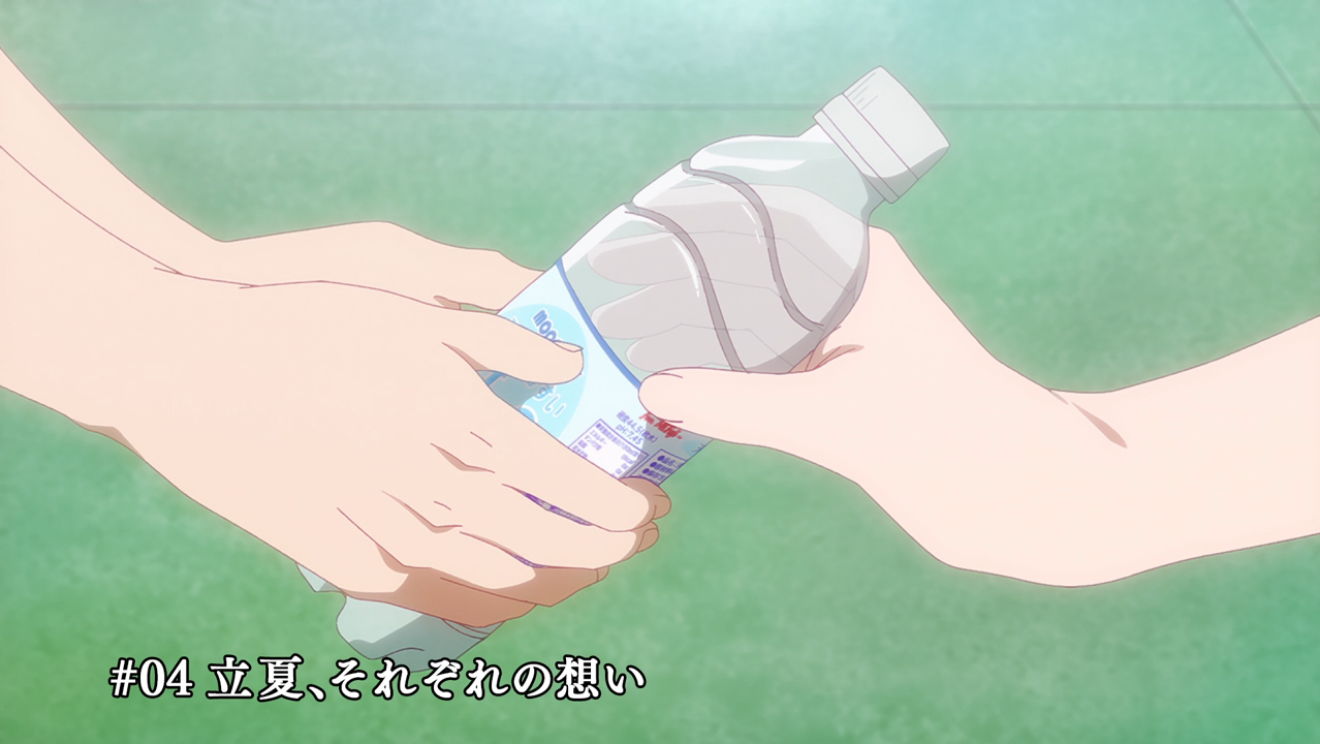
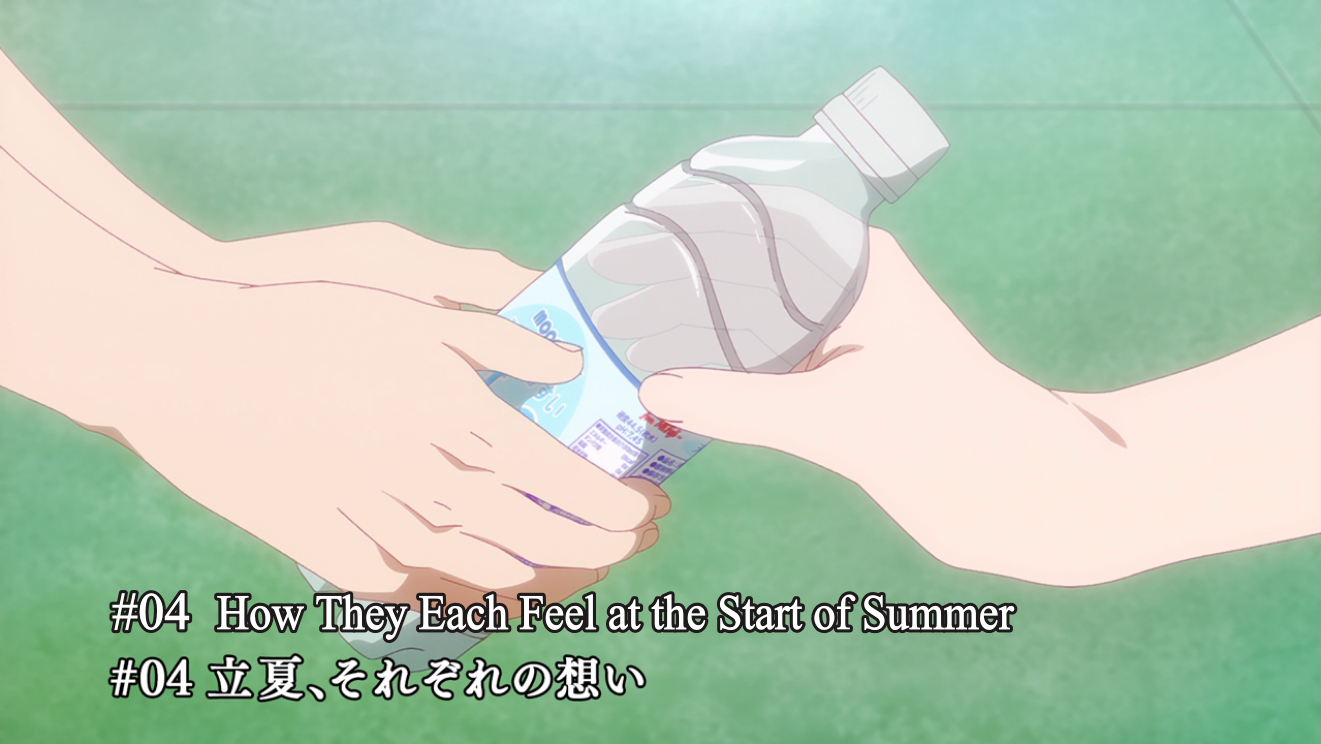
立夏、それぞれの想い
立夏(りっか)
So we have 立 from the verb to stand 立つ. This kanji can mean stand up, rise, or set up.
夏 is one of the four seasons called summer. Just looking at it makes me feel 暑い.
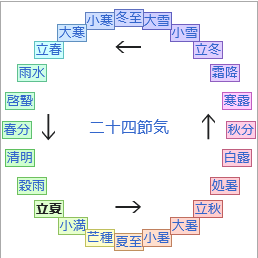
This is a word that describes seasonal changes. Here’s a chart that I found:
This chart is called the 二十四節気(にじゅうしせっき)which is a calendar that splits the solar year into 24(二十四) segments.
立夏 is the “first day of summer”.
それぞれの This can mean either “each” or “respectively” and the の seems to be using possessiveness or it is nominalizing verbs and adjectives. Let’s take a look at the final word and finish the translation.
想(おも)い
The kanji 想 in 想い can mean things like idea or thought. The word itself can mean how someone feels or what they think. Considering this is a noun it is safe to say it is being used as a possessive here. Now that we know we are dealing with how the characters feel about the first day of summer, we can express that in the title.
Perhaps “Everyone’s Feelings about the First Day of Summer”.
Or maybe “Their Feelings at the Beginning of Summer”.
Or “Each of Their Thoughts on the Beginning of Summer”
I’ll go with the last one.
“Each of Their Thoughts on the Beginning of Summer”
Good. Really drives home the meaning.
This title comes from 可愛いだけじゃない式守さん or Shikimori’s Not Just a Cutie. Considering she has the kanji 守 in her name, it goes perfectly with the plot of the show. Shikimori is dating this guy named Izumi Yuu (和泉 幽). She is gorgeous but sometimes she acts like a total badass. I’ll get into that later but first, going back to Yuu’s first name seems a bit foreboding considering it reminds me of the word 幽霊 or ghost.
Thanks to Shikimori he doesn’t have to worry about being one. Because she protects her boyfriend from a lot in this show. Falling down, things falling down to crush him, not even Truck-kun can take this unlucky fellow out thanks to Shikimori.
So far I like the show, but I can see how it can get old fast with the whole “his unluckiness gets him harmed or almost killed and his girlfriend bails him out” spiel.
After healing my Pokemon and getting a few items from the Mart, I went into Ilex Forest. The trees are covering the sky. I wonder if it gets bright here during the day? Found the apprentice but he seems worried. He lost a Pokemon named Farfetch’d. Ah, so they use that Pokemon to cut the charcoal. Sounds convenient. He’s too scared to go look for it. That’s a bit inconvenient. So what if it’s a little dark in here. I’ll look for it myself.
Found it but it keeps running away. Figured out a way to get it back to the entrance. But then a Pokemon named Oddish got in my way. I caught it and named it Mikazuki since it appears to like the moonlight.
All according to plan. The Farfecth’d moved just how I wanted it to. Well almost. It ended up running into some trees but it reached the apprentice just fine. Oh? His master is here.
As thanks he gave me HM 01 “Cut”. Ah so it is like the TMs. So Farfetch’d wouldn’t listen to him because he doesn’t have any gym badges. That’s rough. The apprentice gave me some Charcoal. It’s perfect for fire type Pokemon it seems so I’ll give it to Hanabi. Better than paying 9800 yen for it at the Mart.
Looks like he wants me to work here. It wouldn’t hurt to train one of my Pokemon that can learn Cut, so I stayed there for a day. Mikazuki and Hanabi are the only ones that can learn it, so I trained Mikazuki in the way of the Cut. After a day or two, Mikazuki could cut down small trees with no problem. Before I left the town, I picked up Fast Ball from Kurt.
In conclusion, I hope that this series is helpful with your journey to learning Japanese and/or taking an interest in the country’s culture. Until then… また来週!






 Japanese Practice・日本語の練習
You must be logged in to post a comment.